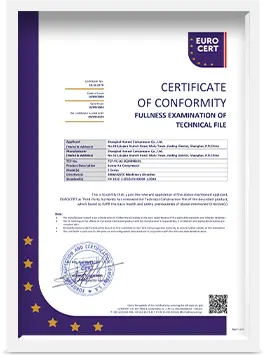
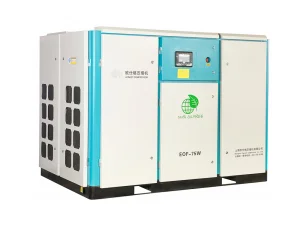
Engineered Heavy-Duty Rotary Screw Compressor Series
Precision-manufactured in Shanghai under ISO 9001 and CE directives. Fully customizable for multinational voltage parameters, severe ambient climates, and hazardous environments.
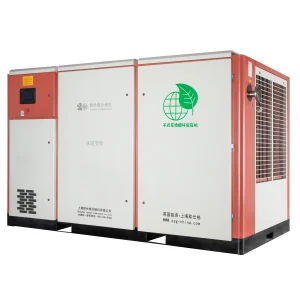
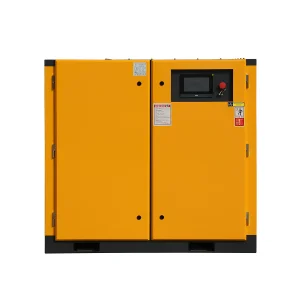
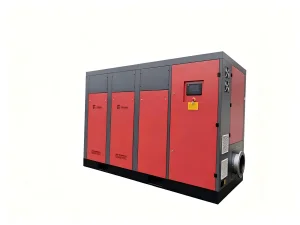
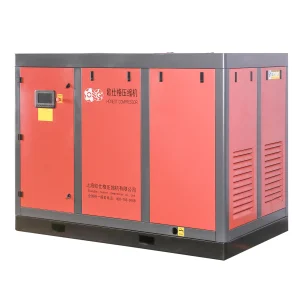
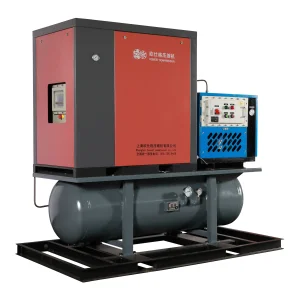
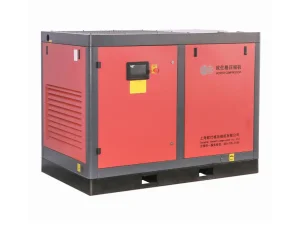
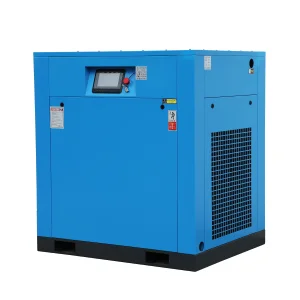
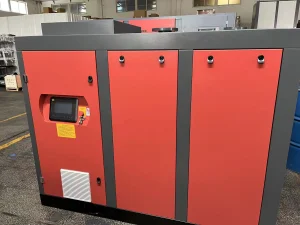
The Mechanics of Industrial Air Compressor Oil-Injected Types
An exhaustive analysis of thermodynamic heat exchange, hydrodynamic boundary lubrication, and micro-droplet separation in rotary twin-screw compression systems.
Thermodynamic Superiority & The Four Pillars of Oil Injection
In the arena of heavy industrial pneumatic infrastructure, the oil-injected rotary screw air compressor (commonly denoted as the oil-type industrial compressor) commands more than 82% of the global manufacturing installed base. Unlike dry-running compression where atmospheric air heats rapidly along an adiabatic curve, the controlled injection of synthetic lubricants directly into the compression chamber alters the cycle toward a near-isothermal process. The specialized lubricant performs four critical, non-negotiable functions within the precision clearances of the male and female rotors:
- Dynamic Thermodynamic Cooling: Injected oil acts as an instantaneous thermal sponge, absorbing the massive heat of compression generated by volumetric air reduction. By capturing up to 80% of thermal energy at source, discharge air temperatures are constrained under 90°C, preventing internal rotor thermal expansion and molecular air degradation.
- Hydrodynamic Rotor Sealing: Machined rotor tolerances operate within micron-scale clearances (typically 25 to 55 microns). The lubricant film provides dynamic fluidic sealing along the rotor contact line and flute profiles, suppressing back-leakage from the discharge port to the suction intake, dramatically increasing volumetric efficiency up to 96%.
- Boundary Film Lubrication: It guarantees continuous hydrodynamic separation between male driven flutes and female idler profiles, as well as mitigating high axial and radial thrust loads across cylindrical roller bearings and angular contact ball bearings.
- Acoustic and Mechanical Damping: The viscous liquid layer absorbs structural harmonics, rotor chatter, and acoustic shockwaves, attenuating operating noise levels from exceeding 68 to 72 dB(A).
Single-Stage vs. Two-Stage Compression Thermodynamic Yield
For global production facilities operating in excess of 4,000 to 8,000 running hours annually, the Specific Power Consumption (measured in kW per m³/min) serves as the primary metric of equipment viability. As industrial air compressor oil-type systems scale above 55 kW, two-stage compression architectures become thermodynamically superior. By dividing the total pressure ratio (Π = P2/P1) across two distinct rotor sets connected in series with an inter-stage oil curtain or atomized cooling spray, the compression work per stage is minimized:
$$\text{Work Reduction} \approx \frac{n}{n-1} P_1 V_1 \left[ \left(\frac{P_i}{P_1}\right)^{\frac{n-1}{n}} + \left(\frac{P_2}{P_i}\right)^{\frac{n-1}{n}} - 2 \right]$$
The thermodynamic intermediate pressure ($P_i = \sqrt{P_1 \cdot P_2}$) significantly reduces the rotor bearing loads, drops inter-stage air temperature, and slashes internal slippage. Consequently, two-stage oil-type compressors engineered by Honest Compressor deliver up to 15% higher energy efficiency compared to conventional single-stage oil-flooded machinery of equivalent electrical rating.
| Technology Class | Lubrication Architecture | Isothermal Efficiency | Residual Oil Content | Maintenance Lifecycle | Typical Industrial Duty |
|---|---|---|---|---|---|
| Oil-Injected Single-Stage VFD | Synthetic PAO / Ester Fluid | 76% - 82% | < 2.0 ppm (mg/m³) | 4,000 h Fluid / 8,000 h Separator | Automotive, Stamping, Machine Tooling |
| Oil-Injected Two-Stage Direct Drive | Inter-Stage Mist Lubricated | 88% - 93% Grade 1 Energy | < 1.5 ppm (mg/m³) | 6,000 h Fluid / 10,000 h Core Overhaul | Petrochemical, Mining, Continuous Glass |
| Dry Oil-Free (EOF Series) | External Lube / Dry Rotor Core | 68% - 74% | 0.00 ppm (ISO Class 0) | Rotor Re-coating at 40,000 h | Biopharma, Wafer Fab, Baby Food |
| Water-Lubricated Oil-Free | Deionized Purified Water | 82% - 86% | 0.00 ppm (Zero Hydrocarbon) | Reverse Osmosis Water Purification | Medical Air, Precision Electronics, Textiles |
Global Procurement Demands: The 10-Year TCO Calculus
Why modern procurement directors look past initial capital expenditure to evaluate the 73% energy factor, ISO 50001 compliance, and localized supply risk.
LCC (Life Cycle Cost) Optimization
Empirical data from over 5,000 industrial installations proves that the purchase price represents only 10% to 12% of a compressor's 10-year total cost. Periodic maintenance constitutes roughly 15%, while electrical power consumption accounts for a staggering 73% to 75%. Procuring an Honest Compressor oil-type system with permanent magnet variable frequency (PM VFD) cuts overall life cycle expenditures by 28% to 42% under fluctuating facility air loads.
Decarbonization & CBAM Compliance
With the European Carbon Border Adjustment Mechanism (CBAM) and strict global ESG reporting standards taking effect, heavy manufacturers in steel, forging, and polymers face heavy penalties for inefficient utility baseloads. Our IE4/IE5 ultra-high efficiency permanent magnet motors, coupled with oil-to-water heat recovery integration capable of recovering 70% of waste heat for boiler feed or space heating, directly drive down Scope 2 greenhouse gas emissions.
Harmonized Electrical Customization
Global buyers consistently encounter supply bottlenecks due to localized grid constraints: 380V/50Hz across Europe/Asia, 460V/60Hz in North America, 400V/50Hz in Australia, or 600V in Canadian mining skids. Honest Compressor’s dedicated ODM engineering divisions design and wind native frequency inverters and multi-tap transformer enclosures in-house, fully certified under CE, UL, CSA, and EAC regulatory frameworks.
China Factory 4.0: Precision Machining & Supply Chain Resilience
Uniting British mechanical heritage established in 2004 with Shanghai's hyper-dense precision manufacturing cluster for unprecedented lead times and batch consistency.
Sub-Micron Rotor Profiling
At the heart of our 50,000 m² Shanghai facility, rotor blanks are ground on ultra-precision German Kapp Niles rotor grinders and Japanese Mazak 5-axis machining centers. With profile tolerances maintained under ±0.003 mm, rotor meshing operates with microscopic clearance lines, eliminating turbulent eddy slippage and delivering maximum volumetric air displacement per kilowatt hour.
100% Full-Load Test Bench per ISO 1217
Zero machines exit our production floor based on theoretical calculations alone. Every single compressor undergoes continuous computerized run-in testing on automated test stands compliant with ISO 1217 Annex C and CAGI standards. Sensors monitor vibration spectrums, volumetric Free Air Delivery (FAD), sound power, pressure dew points, and bearing thermal stabilization prior to export packing.
Agile ODM Engineering & Fast-Track Delivery
Capitalizing on the world's most integrated industrial supply ecosystem within the Yangtze River Delta, our lead time for customized ODM compressors spans just 15 to 25 days—compared to 16 to 24 weeks from traditional European manufacturers. From bespoke PLC firmware in 14 languages to heavy-gauge C5-M marine-coated enclosures, our agile manufacturing line accommodates specialized private-label requirements seamlessly.
Tribology, Lubricant Selection & Multi-Stage Separation Physics
The performance longevity of an industrial air compressor oil-type system rests almost entirely upon the tribological behavior of the lubricant and the aerodynamic efficiency of the air-oil separation vessel. Selecting the correct oil viscosity grade and base stock is critical to preventing premature component fatigue, varnish formation, and thermal breakdown.
Synthetic PAO vs. Polyol Ester vs. Mineral Base Stocks
While standard mineral oils (Group II hydrocracked) suffice for benign, low-temperature operations under 2,000 running hours, modern heavy manufacturing necessitates advanced synthetic polyalphaolefin (PAO) or synthetic ester-based compressor fluids (ISO VG 32, 46, or 68). PAO fluids demonstrate exceptionally high Viscosity Index (VI > 140), phenomenal shear stability, and minimal volatility at discharge temperatures approaching 100°C. They eliminate sludge deposition across thermostatic control valves and oil cooler matrices, extending fluid drain intervals to 8,000 operating hours.
Three-Stage Air-Oil Separation Architecture (< 2 ppm Carryover)
Delivering clean, instrument-grade compressed air while utilizing an oil-flooded airend requires an ultra-efficient three-stage mechanical and coalescing separation circuit:
- Primary Centrifugal Cyclone Separation: The high-velocity discharge stream (air saturated with atomized oil droplets) enters the separation vessel tangentially. Centrifugal force drives large oil droplets (>10 microns) outward against the vessel perimeter, where gravity directs 95% of the bulk oil down into the holding sump.
- Secondary Impingement & Directional Inertia: The pre-separated air changes direction through internal baffle plates, forcing medium-sized droplets (3 to 10 microns) to collide, coalesce, and drain via gravity.
- Tertiary Borosilicate Glass Fiber Coalescing: The air stream traverses a multi-layer micro-glass fiber coalescing separator element. Sub-micron aerosols (down to 0.1 micron) undergo Brownian diffusion and direct interception, agglomerating into liquid droplets on the inner element wall. An internal scavenger tube (scavenge line with an integrated optical sight glass and check valve) vacuums accumulated fluid continuously back into the low-pressure suction port of the airend.
This meticulously calculated separation vessel maintains system differential pressure drops below ΔP 0.02 MPa (0.2 bar), guaranteeing that downstream compressed air carries less than 2 ppm (parts per million) residual oil, easily polished by downstream sub-micro particulate filters to ISO 8573-1:2010 Class 1 oil aerosol criteria.
Engineered for Extremes: Global Industrial Field Cases
From sub-zero mining tundra in Northern Europe to high-ambient humidity in Southeast Asia, our oil-type screw platforms deliver uncompromised reliability.
Automotive Press & Robotic Tooling
In modern automotive assembly lines in Mexico and Eastern Europe, thousands of pneumatic spot welders, high-speed stamping presses, and robotic suction heads demand constant 0.75 MPa line pressure. Pressure dips cause robotic safety trips and multi-million-dollar downtime. Honest Compressor's dual-stage oil-type PM VFD units react to fluctuating flow demands within 50 milliseconds, maintaining system pressure steady within ±0.01 MPa.
Petrochemical & Refinery Off-Gas
Operating in hazardous environments classified under ATEX Zone 1 / Zone 2 or Class I Div 2 mandates uncompromising mechanical and electrical safety. Our 4-in-1 explosion-proof series features Ex d IIB T4 / Ex d IIC Gb rated motors, copper-free cast electrical enclosures, anti-spark fan impellers, and stainless-steel hydraulic oil piping to prevent flammable gas ignition.
Mining, Quarrying & Heavy Metallurgy
In the remote mineral belts of Western Australia, Chile, and Central Asia, compressors face pervasive abrasive silica dust and ambient temperatures swinging from -15°C to +48°C. Our ruggedized oil-type compressors utilize heavy-duty dual-stage nano-synthetic air intake filtration (99.9% filtration efficiency at 1 micron), oversized plate-fin oil coolers with anti-clogging spacing, and thermostatic bypass valves to eradicate thermal condensation.
Procurement & Engineering Knowledge Base (FAQ)
Targeted, search-intent verified engineering answers for plant operations managers, EPC engineering directors, and compressor distributors.
What defines an "oil-type" industrial air compressor, and when is it preferred over oil-free systems? +
How does Honest Compressor guarantee residual oil carryover below 2 ppm in discharge air? +
What are the practical electrical savings of a Two-Stage Oil-Injected Compressor vs. Single-Stage? +
What lubrication maintenance protocol should be executed to maximize airend life? +
How does your ODM service handle regional grid codes and environmental certifications? +
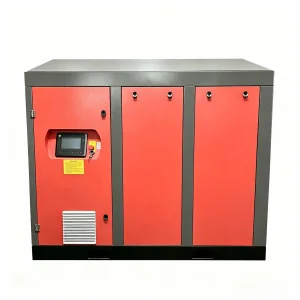
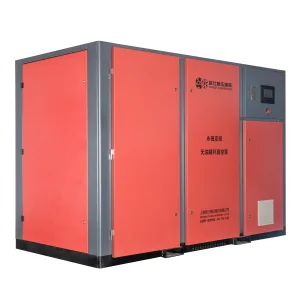
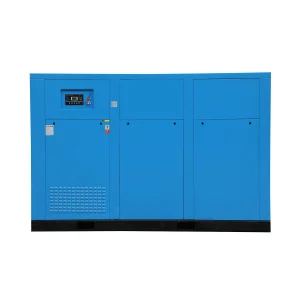
Specialized Heavy Industrial Blower, Vacuum & Dual-Stage Skids
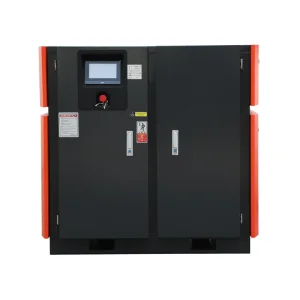
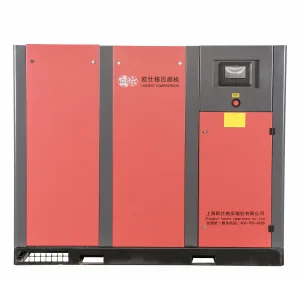
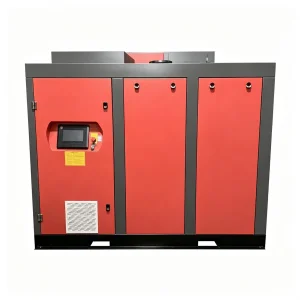
High-capacity rotary screw platforms optimized for low-pressure pneumatic transport, chemical vacuum recovery, and continuous baseload power.
Accelerate Your Industrial Compressor Sizing & RFQ
Direct collaboration with Shanghai Honest Compressor Co., Ltd.’s chief application engineers. Receive detailed CAD layout envelopes, specific power performance curves, and turnkey containerized skid proposals within 24 business hours.
1. Operating Baseline
Specify your required Free Air Delivery (FAD in m³/min or CFM) and terminal operating pressure (bar or MPa). Indicate whether your site load profile displays continuous baseload consistency or severe cyclic peaks requiring PM VFD modulation.
2. Electrical & Ambient
Specify site supply voltage (380V, 400V, 415V, 460V, or 690V at 50/60Hz), site elevation above sea level, maximum ambient summer temperatures (>45°C requires tropicalized oversized coolers), and any hazardous dust or flammable vapor classifications.
3. Downstream Quality Class
Define target ISO 8573-1 air purity standards. We engineer integrated skids including refrigerant or desiccant adsorption dryers, carbon towers, and particulate filters to achieve pressure dew points down to -40°C or -70°C.