High-Efficiency Two-Stage Compressors for Kansai Manufacturing
Configured for 200V / 220V 60Hz Japanese grid stability, continuous thermal endurance, and verified low specific energy consumption per m³/min.
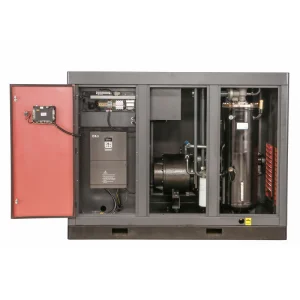
Osaka Smart Series: Oil-Cooled Two-Stage PM VFD Compressor
- Dual-stage ratio minimization
- Oil-cooled permanent magnet motor
- JIS 200V/220V 60Hz compatible
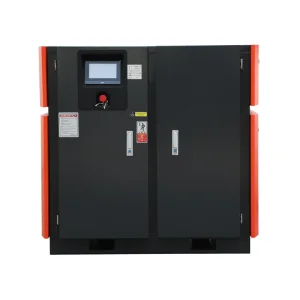
Hanshin Industrial: Horizontal Two-Stage Pressure Screw Compressor
- Horizontal low-vibration rotor layout
- Optimal interstage oil-injection cooling
- Continuous 24/7 duty rating
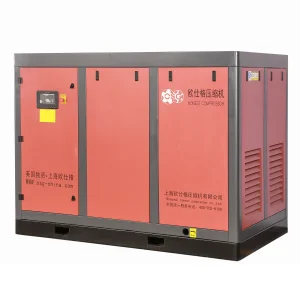
55kW (75HP) Two-Stage Industrial Machine for Osaka Monozukuri
- IP55 heavy ingress-protected housing
- Reduced thermal and mechanical load
- Precision machined airend rotors
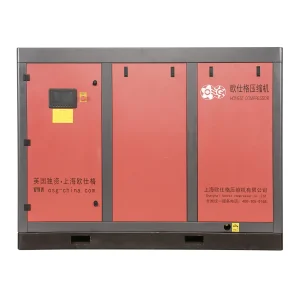
Direct Drive 55kW 7–13 Bar Two-Stage VSD Inverter System
- 1:1 Direct drive without transmission loss
- Vector frequency regulation 25%–100%
- Smart IoT telematics & remote monitoring
Industrial Reality & Decarbonization Pressures in the Osaka Prefecture
The Osaka metropolitan basin forms the historical core of Western Japan's industrial powerhouse—the Hanshin Industrial Region (阪神工業地帯). Comprising heavy coastal complexes across Sakai-Senboku (堺・泉北臨海工業地帯), dense advanced precision metalworking networks in Higashiosaka (東大阪), high-precision electronics manufacturing in Kadoma, and sophisticated pharmaceutical and biochemical clusters in Northern Osaka (Doshomachi and Saito Bio-cluster), this industrial fabric relies extensively on compressed air as the critical "fourth utility."
However, industrial plant operators across Osaka face acute macroeconomic and operational constraints. Electricity costs administered through the Kansai Electric Power Co. (KEPCO / 関西電力) grid have witnessed persistent upward volatility following structural fuel adjustments and global supply chain recalibrations. Under Japan’s revised Act on the Rational Use of Energy (Energy Conservation Act / 省エネ法) and the national mandate toward Green Transformation (GX), manufacturing plants in Osaka are required to systematically reduce specific energy consumption by at least 1% annually.
In standard manufacturing plants, compressed air systems account for 20% to 35% of total plant electrical consumption. More critically, over an average operating lifecycle of 10 years, the initial purchase capital of an air compressor represents merely 8% to 12% of total cost of ownership (TCO), while electric utility bills consume upwards of 75% to 82%. Single-stage rotary screw compressors, long the workhorses of mid-tier Japanese factories, are hitting fundamental thermodynamic limits. For Osaka manufacturers aiming to retain global cost competitiveness while satisfying municipal carbon neutrality roadmaps, transitioning to high-efficiency Two-Stage Rotary Screw Air Compressors is no longer an optional upgrade—it is a vital operational prerequisite.
Thermodynamic Mechanics: Why Two-Stage Compression Wins in Osaka
By dividing the compression ratio across two distinct rotary stages with intermediate cooling, energy consumption approaches the ideal isothermal curve.
Isothermal Compression Proximity
Single-stage compression acts near-adiabatically, generating extreme heat and wasted mechanical energy. Two-stage architectures cool the air between stages, drastically lowering the work required for second-stage compression and saving up to 15% specific power.
Lowered Pressure Ratios & Leakage
Dividing an 0.8 MPa overall compression ratio into two stages lowers the individual compression ratio to approximately 2.8 per stage. Internal backflow and rotor-to-housing clearances experience substantially reduced pressure differentials, eliminating bypass leakage.
Extended Bearing & Rotor Life
Lower pressure ratios across each rotor set reduce axial and radial thrust loads on heavy-duty SKF angular contact bearings. The mechanical life expectancy of the compression element extends past 100,000 running hours with minimal wear profiles.
| Performance Characteristic | Standard Single-Stage Screw | Two-Stage Fixed Speed Screw | OEM Two-Stage PM VFD (Our Osaka Build) |
|---|---|---|---|
| Specific Power Input (kW / m³/min @ 0.8 MPa) | 7.2 – 8.1 kW/(m³/min) | 6.4 – 6.8 kW/(m³/min) | 5.6 – 6.1 kW/(m³/min) |
| Compression Stage Ratio (ε) | 1:8.0 to 1:9.0 | Stage 1: ~2.8 | Stage 2: ~2.9 | Stage 1: ~2.7 | Stage 2: ~2.8 |
| Motor Efficiency Classification | IE3 (Premium Efficiency) | IE3 or IE4 | IE5 Ultra-Premium PM Motor |
| Turndown Modulation Capability | Inlet throttle / blow-off (High idle loss) | On/Off Dual Control (30% idle power) | Dynamic VFD (25% to 100% capacity matching) |
| Discharge Temperature (Airend Exit) | 85°C – 102°C | 75°C – 88°C | 68°C – 78°C (Intercooled) |
| 10-Year Total Energy Cost (75kW, 8000h/yr) | JPY ¥132,000,000 | JPY ¥114,800,000 | JPY ¥98,200,000 (~25.6% Total Savings) |
Engineered for Kansai's Grid & Environmental Conditions
Addressing unique Japanese manufacturing standards, grid frequencies, and coastal climate challenges.
1. 200V / 220V 60Hz Electrical Architecture
Japan features a split national electrical frequency: Eastern Japan operates on 50Hz, while Western Japan (including Osaka, Kobe, Kyoto, and Wakayama) operates strictly on 60Hz at nominal voltages of 200V three-phase (or 220V industrial feed). Standard import air compressors calibrated for 380V/400V 50Hz systems cannot simply be retrofitted with transformer step-ups without inducing significant inductive reactance penalties, motor thermal saturation, and inverter harmonic distortion.
Our OEM air compressors designed for Osaka feature tailor-wound stators configured natively for low-voltage, high-amperage 200V/220V 60Hz. We integrate Japanese-grade inverters with line reactors and EMC/EMI harmonic filters compliant with JEMA (Japan Electrical Manufacturers' Association) specifications, preventing interference with sensitive CNC tool centers, wire EDM machines, and automated robotic PLC arrays in crowded manufacturing plants.
2. Osaka Summer Humidity & Interstage Dew Point Management
Osaka’s climate in summer (July through September) brings ambient temperatures exceeding 37°C accompanied by relative humidity levels surpassing 85%. In two-stage compression, cooling the air between the first and second stage poses a known physical hazard: condensation dropping out inside the interstage passage.
If liquid water droplets enter the second-stage rotor cavity, they cause oil emulsification, accelerate boundary lubricant degradation, and initiate micro-pitting on rotor contact lines. Our Osaka-spec engineering integrates an automated thermal mixing valve combined with an active vortex moisture separator before the stage-two suction port. This ensures the compressed air stays consistently 3°C to 5°C above pressure dew point while maximizing thermodynamic density gains.
3. Acoustic Attenuation for Urban SME Plants
In Higashiosaka and Yao, industrial workshops frequently abut residential neighborhoods or dense commercial alleys. Under Osaka municipal noise pollution ordinances, property boundary sound levels must typically remain below 65 dB(A) during daytime and below 55 dB(A) at night.
Our two-stage compressors utilize internal labyrinth sound baffles, high-density non-flammable acoustic foam insulation, vibration-isolated base rails, and ultra-quiet variable-speed centrifugal cooling fans. Even under 100% full load, sound levels register between 62 dB(A) and 68 dB(A), allowing indoor installation without dedicated, costly soundproof vaults.
Localized Applications Across Osaka Industrial Sectors
Tailored delivery packages built for the operational reality of regional factories.
Fiber Laser Cutting (16–20 Bar)
Higashiosaka’s metal sheet job shops are transitioning from high-cost liquid nitrogen assist gas to high-pressure compressed dry air. Our boosted two-stage screw platforms provide dry, oil-free Class 1:2:1 compressed air at 1.6 to 2.0 MPa for dross-free laser cutting of stainless and carbon steels.
Sakai-Senboku Petrochemicals
Continuous process control in chemical refineries requires explosion-resistant Class 1 Div 2 (Ex d IIB T4) engineering, redundant sensor channels, and uninterrupted air volume for pneumatic actuator loops, instrument purges, and nitrogen generation feed streams.
Kansai Pharma & Food Processing
In Doshomachi pharmaceuticals and regional food packaging facilities, compressed air touches pill blistering, filling machines, and pneumatic conveying lines. We engineer Class 0 oil-free dry screws and water-lubricated units to ensure complete absence of hydrocarbon aerosols.
OEM/ODM Manufacturing Infrastructure & Quality Control
From British-heritage design standards to precision rotor profiling and comprehensive full-load run-in testing.
Founded in early 2004 as a British-invested pneumatic engineering enterprise, Shanghai Honest Compressor Co., Ltd. operates a standardized 50,000 m² smart manufacturing campus in Jiading District, Shanghai. Our OEM/ODM capabilities are dedicated to providing Japanese trading partners, engineering contractors, and private-label distributors with superior manufacturing consistency.
Core In-House Capabilities for the Japanese Market:
- High-Precision Rotor Profile Grinding: We utilize advanced German and British rotor grinding centers to maintain asymmetric 5:6 tooth profile tolerances within ±2 microns. This tight tolerance minimizes blow-hole leakage between compression pockets.
- Full CMM Coordinate Inspection: Every finished airend housing undergoes multi-axis coordinate measuring machine (CMM) dimensional verification under temperature-controlled cleanroom conditions prior to assembly.
- Dynamic Rotor Balancing: Rotors are balanced to ISO 1940 Grade G1.0 standards, ensuring low operating vibration levels (< 1.5 mm/s) that protect bearings and minimize structural fatigue.
- Full-Load Run-In Factory Acceptance Testing (FAT): Every compressor destined for the Osaka market undergoes a rigorous 4-hour continuous full-load run-in test on our automated testing station. Free Air Delivery (FAD) is verified in strict compliance with ISO 1217:2009, Annex C / JIS B 8341, measuring actual delivered flow, motor input kW, and specific power consumption.
- Flexible OEM Branding & Localization: We supply units with custom cabinet colors, private-label silk-screen branding, Japanese PLC interface software (touchscreens supporting Kanji/Kana text), custom alarm triggers, and tailored Modbus RTU / Profinet industrial gateway cards.
Frequently Asked Questions: Osaka Industrial Procurement
Engineering, compliance, and energy savings answers for factory managers and procurement directors.
1. How does a two-stage screw compressor achieve 15–20% energy savings over single-stage units?
2. Are your compressors natively compatible with Osaka’s 200V / 220V 60Hz industrial power grid?
3. Can your controllers display Japanese language and integrate into local SCADA systems?
4. What is the expected payback period for an Osaka plant replacing a single-stage machine?
5. How does your factory prevent condensation issues during humid Osaka summers?
6. What OEM / private labeling services do you provide for Japanese air compressor distributors?
7. What international and Japanese performance standards do your units comply with?
8. How do you support spare parts availability and after-sales maintenance in Western Japan?
9. What is the warranty policy on the two-stage airend and permanent magnet motor?
10. Can you supply integrated heat recovery systems for plant space heating or boiler preheating?
Full Industrial Series: Screw Compressors, Blowers & Vacuum Pumps
Explore our complete range of oil-free, high-pressure, vacuum, and blower systems engineered for modern industrial facilities.
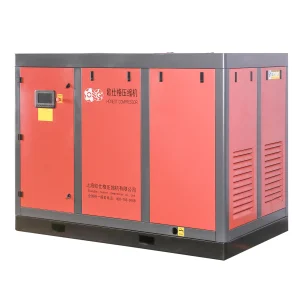
Sakai Petrochem: OEM Two-Stage Heavy Air Compressor
- High-volume flow rates up to 55 m³/min
- Ex d IIB explosion resistance available
- Designed for heavy continuous duty
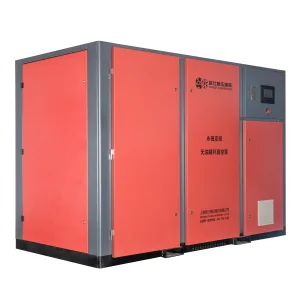
Osaka Precision: PM VFD Dry Oil-Free Screw Vacuum Pump
- Clean, 100% oil-free vacuum chamber
- Variable frequency speed control
- Eliminates oil vapor backstream
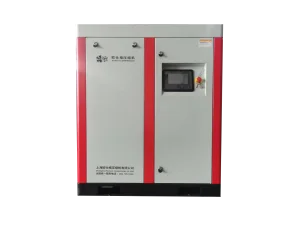
30kW Water-Lubricated Oil-Free VSD Screw Compressor
- Zero hydrocarbons, pure water seal
- ISO 8573-1 Class 0 certified air
- Stainless steel rotor metallurgy
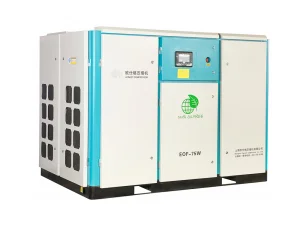
55kW–315kW Industrial Dry-Type Oil-Free Screw Compressor
- Heavy industrial dry screw airend
- Fixed speed or VSD PM drive options
- Food, semiconductor & pharma ready
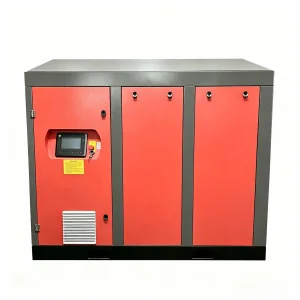
Osaka Environmental: PM VSD Oil-Free Screw Blower
- 30% more efficient than Roots blowers
- Wastewater aeration & pneumatic feed
- Ultra-low operating pulsation
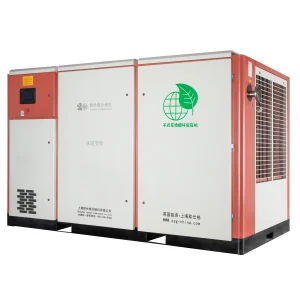
EOF Series: 100% Oil-Free Dry Screw PM VFD Compressor
- PTFE rotor coating for longevity
- Zero downstream oil filtration burden
- Precision pressure holding ±0.01 MPa
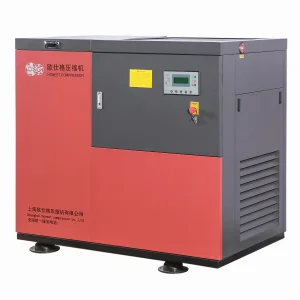
20 Bar Dedicated Screw Compressor for Fiber Laser Cutting
- High pressure 1.6–2.0 MPa output
- Integrated refrigerated air dryer
- Compact footprint for metal workshops
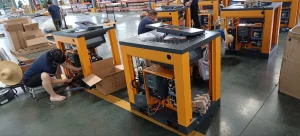
10A-PM Compact Permanent Magnet Frequency Screw Compressor
- Compact form factor for small bays
- Single-phase / 3-phase options
- Ultra-quiet running under 62 dB(A)
Partner with an Experienced Two-Stage OEM Compressor Factory
Whether you need a custom-engineered 200V 60Hz two-stage air compressor for an Osaka manufacturing plant or a private-label distribution line for the Kansai region, our engineering team is ready to evaluate your airflow requirements, duty cycles, and energy-saving goals.
Send Inquiry Now