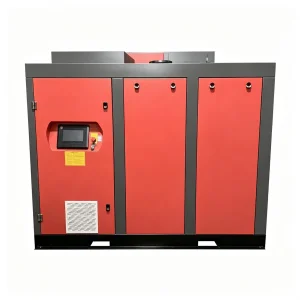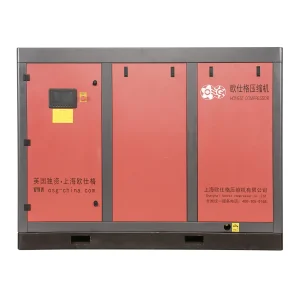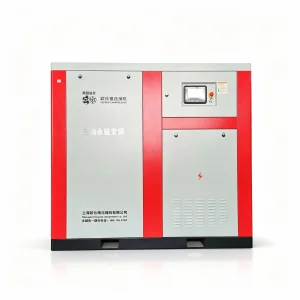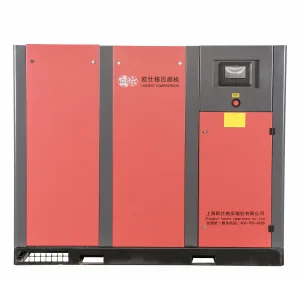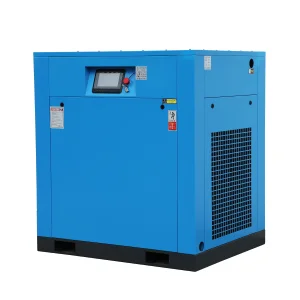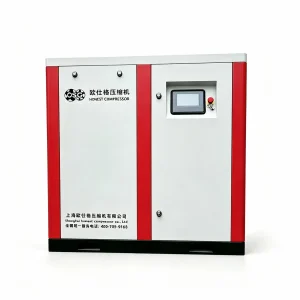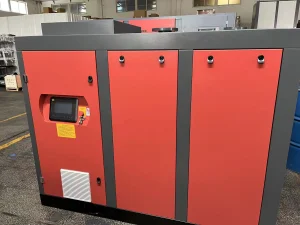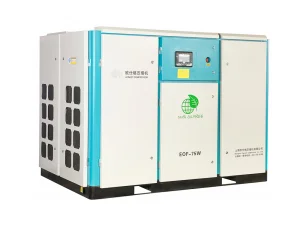
High-Capacity Heavy-Duty Compression Machinery
Continuous-duty air ends, variable-displacement permanent magnet drivetrains, and clean water-lubricated architectures designed to reduce specific power consumption across massive factory environments.
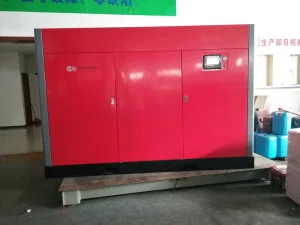
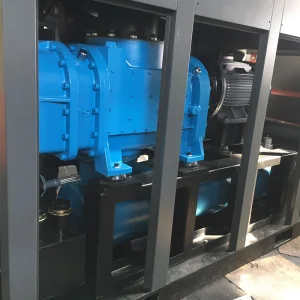
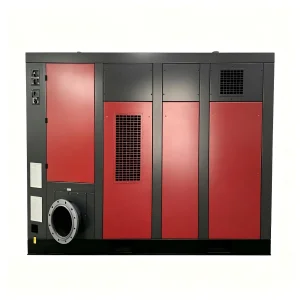
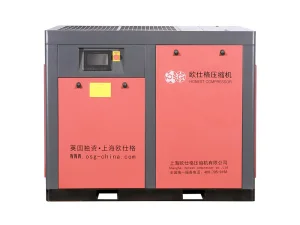
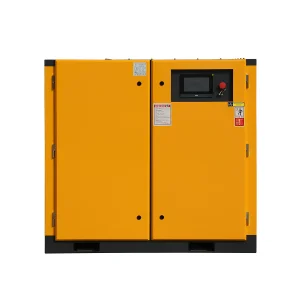
The Commercial & Operational Reality of Large Industrial Air Infrastructure
Compressed air systems consume approximately 10% of total electrical power deployed across manufacturing sectors globally. In heavy-duty process plants, compressed air is regarded as the "Fourth Utility" after water, gas, and electricity.
Life-Cycle Cost Disproportion
Over a ten-year operational timeline, initial capital investment (CAPEX) accounts for only 8% to 12% of total compressor expenditure. Routine maintenance equates to 10% to 15%, while electrical power consumption accounts for an overwhelming 73% to 78% of the plant's Life-Cycle Cost (LCC).
Consequently, industrial manufacturing enterprises, petrochemical refineries, and continuous automotive plants can no longer tolerate low-efficiency rotary equipment that dumps kW into parasitic mechanical heating.
Supply Chain Realignment
China has evolved from an assembly hub for standardized small piston units into the world's foremost engineering epicenter for large-frame, high-power twin-screw and centrifugal compressor packages.
With indigenous CNC five-axis rotor milling machines, proprietary ultra-precision 5:6 asymmetric screw profiles, and integrated rare-earth permanent magnet electric motor fabrication, Chinese manufacturers provide Tier-1 thermodynamic performance at 30% to 45% lower capital deployment.
Stringent Emission Mandates
The enforcement of global Net-Zero initiatives, EU CBAM (Carbon Border Adjustment Mechanism), and China's GB19153 Level-1 Energy Standards has elevated compressor selection into a core boardroom metric for ESG compliance.
Procurement executives are actively phasing out inefficient throttled inlet single-stage compressors in favor of variable-frequency intercooled two-stage compressors and ISO 8573-1 Class 0 zero-oil clean air packages.
Engineering Principles & Aerodynamic Thermodynamics
Understanding the physics of continuous gas compression: why thermodynamic design, intermediate phase intercooling, and permanent magnet flux distribution are critical to plant uptime.
Two-Stage Compression vs. Single-Stage Thermodynamics
When air is compressed in a single chamber from 1 bar absolute to 8 bar gauge, internal discharge temperatures can spike above 95°C to 110°C. High temperature increases internal air back-leakage across rotor clearance gaps and sharply increases the theoretical work of compression (polytropic exponent n ≈ 1.35–1.40).
By dividing the compression ratio between two distinct rotor sets—Stage 1 boosting from 0.1 MPa to ~0.32 MPa, followed by a dense atomized oil-mist or inter-stage cooling curtain, and Stage 2 finalizing to 0.8–1.3 MPa—the compression line shifts directly toward the ideal isothermal curve (n ≈ 1.0).
This aerodynamic division cuts inter-stage back-leakage across rotor lines by more than 60%, prolongs bearing life by equalizing axial load vectors, and saves up to 15% specific energy (kW/m³/min) relative to traditional single-stage designs.
Rare-Earth Permanent Magnet (VSD PM) Rotor Dynamics
Conventional induction motors rely on rotor currents induced across squirrel-cage bars, generating continuous rotor copper losses and degrading in efficiency when operating below 65% of rated RPM.
Our IE4/IE5 ultra-high-efficiency synchronous Permanent Magnet (PM) motors feature NdFeB (Neodymium Iron Boron) permanent magnetic elements embedded inside the rotor core. This eliminates rotor excitation power losses and holds electrical efficiency above 96.5% even during turn-down operations down to 25% plant load.
Combined with high-frequency vector-controlled variable frequency drives (VFD), the compressor dynamically accelerates or decelerates in real-time response to manifold pressure drops, eliminating continuous no-load idling wastage (which otherwise burns 30% to 40% full-load power while generating zero air).
Water-Lubricated Class 0 Oil-Free Purity Mechanism
In sensitive pharmaceutical, electronic packaging, and clean chemical syntheses, any trace of aerosol hydrocarbon lubricants (even 0.01 mg/m³) will cause catalytic poisoning, circuit etching failures, or catastrophic batch contamination.
Our single-screw / twin-screw water-lubricated engineering platform utilizes purified, closed-loop demineralized water as the compression sealant, coolant, and bearing hydrodynamic fluid. Water exhibits a specific heat capacity nearly four times higher than synthetic mineral oils.
Consequently, the water mist absorbs compression enthalpy directly at the shear plane, sustaining near-perfect isothermal compression (chamber discharge temperatures stay below 45°C–50°C). Air output achieves strict zero-oil compliance validated under ISO 8573-1 Class 0 parameters.
Dry Screw Vacuum & Multi-Lobe Blower Gas Dynamics
Industrial pneumatic conveyance and degassing operations historically relied on liquid-ring vacuum pumps or mechanical Roots blowers. However, liquid ring systems suffer from fluid vapor pressure limits and massive contaminated wastewater streams.
Our oil-free rotary screw blowers and variable-pitch dry vacuum pumps apply non-contacting, intermeshing screw rotors rotating at high surface velocities. Synchronized via precision timing gears, rotors compress gas internally from suction port to discharge end without seal fluids.
This delivers high volumetric efficiencies (exceeding 85% compared to 55% for conventional lobe roots blowers) and cuts factory electrical drive demand by up to 30% across low-pressure wastewater aeration and pharmaceutical vacuum distillation lines.
| Technology Platform | Nominal Power Band | Working Pressure | Specific Power (kW / m³/min) | Thermodynamic Efficiency | Ideal Application Scenario |
|---|---|---|---|---|---|
| Single-Stage Fixed Speed Screw | 15 kW – 132 kW | 0.7 – 1.0 MPa | 7.2 – 8.1 kW/(m³/min) | Standard Reference | Steady load light manufacturing |
| Two-Stage Direct Drive Screw | 55 kW – 315 kW | 0.7 – 1.3 MPa | 5.8 – 6.4 kW/(m³/min) | +15% to 18% Gain | Heavy chemical, 24/7 continuous process |
| Two-Stage PM VFD Double Motor | 75 kW – 450 kW | 0.6 – 1.3 MPa | 5.4 – 6.1 kW/(m³/min) | +22% to 35% Gain | Fluctuating multi-shift automotive/assembly |
| Water-Lubricated Class 0 Screw | 30 kW – 110 kW | 0.7 – 1.0 MPa | 6.4 – 7.1 kW/(m³/min) | Near-Isothermal | Pharma, beverage bottling, semiconductor |
| Oil-Free Dry Screw Blower | 22 kW – 160 kW | 30 – 120 kPa | Internal compression | +30% vs Roots Lobe | Wastewater biological aeration, pneumatic conveying |
Sector-Specific Solutions for Heavy Industrial Operating Environments
Industrial installations require engineered balance between gas cleanliness, pulsation dampening, hazardous zone protection, and duty-cycle survivability.
Petrochemical & Refinery Complexes
The Engineering Challenge: Continuous 8,760-hour annual operational duty inside volatile ambient zones containing flammable hydrocarbon fractions, sulfur fumes, and heavy airborne particulates.
Our Industrial Deployment: 250 kW to 315 kW explosion-proof two-stage compressor installations certified for Ex d IIB T4 / Ex d IIC T4 zones. Equipped with heavy-gauge stainless steel gas cooling circuits, dual-redundant PLC automation cabinets, anti-spark copper alloy fan impellers, and oil-free nitrogen sealing buffers to isolate flammable atmospheric elements.
Semiconductor & Clean Microelectronics
The Engineering Challenge: Extreme sensitivity to silicone oils, particulate counts, and minute pressure ripples that induce vibration deviations in robotic lithography and wafer transport lines.
Our Industrial Deployment: 100% Water-Lubricated Class 0 screw configurations engineered with non-shedding ceramic bearings and mirror-polished medical-grade 316L stainless steel air delivery manifolds. Integrated with thermal regenerative desiccant dryers achieving constant -70°C pressure dew point (PDP), ensuring sterile, condensate-free pneumatic automation.
Automotive Stamping, Welding & Paint Shops
The Engineering Challenge: Highly variable air consumption curves characterized by violent pressure drawdowns during pneumatic stamping press cycles, contrasted with zero-crater paint spray line criteria.
Our Industrial Deployment: Multi-unit synchronized master-slave clusters pairing base-load two-stage compressors with dynamic high-response Permanent Magnet VFD compressors. Centralized IoT controllers modulate compressor speeds across millisecond thresholds, maintaining ring line headers within ±0.01 MPa pressure tolerances.
Municipal Wastewater & Environmental Engineering
The Engineering Challenge: Continuous, unthrottled low-pressure aeration basin demand (40–80 kPa) consuming over 50% of the entire water treatment facility's municipal electrical grid quota.
Our Industrial Deployment: Low-pressure oil-free rotary screw blowers replacing heritage tri-lobe Roots units. Featuring intermeshing internal-compression helical screws, delivering laminar pulsation-free high-volume air output, lowering site acoustic signatures below 72 dB(A), and slashing annual energy budgets by up to 32%.
Mining, Tunneling & Underground Mineral Extraction
The Engineering Challenge: Deep-shaft high-dust operations with long pneumatic pipeline transmission runs, extreme humidity, high ambient temperature, and volatile voltage drops.
Our Industrial Deployment: Heavy-duty skid-mounted integrated compressor packages equipped with multi-cyclone heavy-particulate inlet filtration, wide-voltage tolerance electrical switchgear (380V/400V/415V/660V ±15%), and ultra-durable direct couplings engineered for harsh continuous subterranean operation.
Cryogenic Separation & Industrial Gas Bottling
The Engineering Challenge: High-pressure gas boost requirements (up to 3.0–4.0 MPa) requiring minimal moisture carryover prior to cold-box expansion cycles and membrane nitrogen generation.
Our Industrial Deployment: Multi-stage boosted screw-piston hybrid packages engineered with closed-circuit synthetic polyolester lubricants, water-cooled Shell-and-Tube heat exchangers, and automatic microprocessor condensate blow-off systems ensuring stable intake gas properties for separation membranes.
System Optimization: Heat Energy Recovery Systems (HRS)
Up to 94% of the electrical energy supplied to an industrial screw compressor is converted into thermodynamic heat. Rather than venting this thermal energy to the atmosphere via air-cooled radiator banks, our factory-integrated Heat Recovery Systems channel hot oil and discharge gas through high-efficiency plate heat exchangers. This generates industrial hot water at 70°C to 85°C for boiler feed preheating, plant heating, or CIP washdown cycles—slashing plant boiler fuel costs and delivering complete payback within 6 to 14 operational months.
Technology Roadmap & Next-Generation Engineering Trends
The convergence of high-speed aerodynamics, artificial intelligence, and magnetic levitation is revolutionizing industrial air generation architectures worldwide.
AI Dynamic Twin Pressure Tuning
Conventional compressed air headers maintain an artificially high buffer pressure (e.g., 0.80 MPa) to hedge against sudden equipment drawdowns. Every 0.1 MPa (1 bar) excess pressure increases compressor electrical consumption by 7% to 8%.
Next-generation Chinese large compressor systems utilize edge-computing algorithms integrated with shop-floor IoT sensors. By predicting machinery duty cycles in real time, the compressor cluster lowers header pressure to the exact minimum envelope (e.g., 0.68 MPa), cutting baseline utility consumption by up to 10% automatically.
Predictive Spectral Vibration Telemetry
Unscheduled compressor airend seizures shut down production lines and cost hundreds of thousands of dollars per hour. Our forward engineering incorporates high-frequency tri-axial accelerometer sensors embedded directly onto rotor bearing housings.
Fast Fourier Transform (FFT) vibration spectrums are continuously analyzed via cloud diagnostics. Early bearing raceway micro-pitting, gear tooth backlash anomalies, or rotor imbalance signatures are flagged months before any thermal or acoustic threshold warning occurs.
Active Magnetic Bearing (AMB) Integration
Mechanical roller bearings impose friction limits and demand sacrificial lubricant changes. The compressor frontier is actively commercializing active magnetic levitation bearings for high-output single and multi-stage turbo-compressors and large blowers.
By suspending the rotating shaft in a high-speed magnetic field running at up to 60,000 RPM, mechanical contact friction drops to zero. Mechanical degradation is eliminated, oil-free operational life extends beyond 20 years, and electrical efficiency reaches unprecedented heights.
Engineering & Sizing Decision Matrix
Technical specifications, installation calculations, and compliance verification criteria compiled by our lead application engineers for global procurement teams.
What parameters are essential to precisely calculate Free Air Delivery (FAD) and motor sizing?
To accurately size an industrial compressor without risking electrical tripping or severe pressure drops, our engineering team requires:
1. Required Volumetric Delivery: Normalized in m³/min, Nm³/h, or CFM measured strictly under ISO 1217 Annex C conditions.
2. Nominal Dynamic Operating Pressure: Measured in bar(g) or MPa at the point of end-use consumption, accounting for distribution piping frictional drops (typically 0.05–0.1 MPa).
3. Site Elevation and Ambient Atmospheric Pressure: Compressors operated at high altitudes (e.g., >1,000 meters above sea level) encounter lower air density. A derating calculation factor must be applied to intake mass flow and motor thermal cooling efficiency.
4. Electrical Grid Parameters: Supply voltage (380V, 400V, 415V, 460V, 690V, or medium voltage 6kV/10kV), supply frequency (50 Hz or 60 Hz), and allowable harmonic distortion limits for VFD drives.
5. Air Purity Requirement per ISO 8573-1: Dictating whether an oil-injected screw with downstream coalescing filtration suffices or whether an ISO 8573-1 Class 0 oil-free platform is legally mandated.
Why does a Two-Stage Screw Compressor provide superior energy efficiency over a Single-Stage machine?
The thermodynamic secret lies in the compression ratio and inter-stage cooling. In a single-stage compressor delivering 0.8 MPa, the pressure ratio across a single set of rotors is roughly 9:1. This extreme ratio induces large thermal expansion, wide rotor clearance tolerances, and substantial back-leakage of compressed gas from high pressure to low pressure.
A two-stage machine distributes this work: Stage 1 operates at a gentle ratio of ~3:1, discharging into an inter-stage cooling chamber. Here, an atomized coolant mist reduces the compressed air temperature before it enters Stage 2 for final compression (ratio ~3:1). Cooling the air reduces its specific volume, so Stage 2 requires substantially less mechanical shaft work to compress the same mass of gas. This saves 15% to 20% in electricity and significantly reduces bearing thrust loads.
How do Permanent Magnet (PM) VFD compressors prevent grid harmonic interference in large factories?
When massive variable-frequency drives (e.g., 75 kW to 315 kW) switch high direct currents, they can inject harmonic currents into the factory electrical network, potentially disturbing PLCs, CNC machines, and capacitor banks.
Our large industrial VFD packages come factory-configured with heavy-duty DC link chokes and AC input line reactors (3% to 5% impedance) as standard. For installations with strict IEEE 519 compliance standards, we incorporate 12-pulse rectifier topologies or Active Front End (AFE) active harmonic filters, holding Total Harmonic Current Distortion (THDi) strictly below 5%. Furthermore, soft-start capabilities eliminate inrush currents completely (0% starting surge compared to 600% on Direct-On-Line motors).
What are the practical maintenance intervals and operational life of Chinese industrial screw air ends?
Our heavy-duty twin-screw air ends are precision ground using high-grade forged alloy steel rotors and housed in high-tensile meehanite cast-iron casings. Critical rotor shafts are supported by paired heavy-duty SKF Explorer or Timken angular contact bearings.
Under standard operating conditions (discharge temperatures maintained at 75°C–85°C with genuine synthetic lubricants):
• Air Filter / Oil Filter Maintenance: 2,000 to 4,000 operational hours.
• Synthetic Coolant Replacement: 4,000 to 8,000 operational hours.
• Air-Oil Separator Element Life: 4,000 to 8,000 operational hours (<3 ppm residual oil content).
• Airend Bearing Design Life (L10h): Rated between 60,000 and 100,000 operational hours before routine bearing overhaul is required.
How does Honest Compressor support overseas EPC contractors with OEM/ODM customization?
With over two decades of dedicated export engineering, Shanghai Honest Compressor delivers turnkey OEM and ODM project customization:
• Electrical Adaptability: Custom motors built for 200V, 220V, 380V, 400V, 415V, 440V, 460V, or 660V at 50Hz or 60Hz with CE, UL, or CSA compliance certification.
• Structural Skid Engineering: All-in-one containerized enclosures, soundproofing down to 65 dB(A), integrated air receiver tanks, refrigerated/desiccant dryers, and multi-stage filtration packages.
• Industrial Telemetry: Microprocessor controllers supporting multilingual touchscreens (English, Spanish, Russian, Arabic, French) with Modbus-RTU, Profibus, and Ethernet IoT remote monitoring protocols.
• Export Packaging: Heavy-gauge anti-corrosive vacuum foil wrapping inside solid seaworthy fumigated wooden crates, fully certified for long-distance maritime freight.
Specialized Screw Compressors, Vacuum Pumps & Blowers
From heavy-flow vacuum evacuation systems to dry oil-free air compressors up to 315 kW, explore our full precision-engineered industrial machinery line.