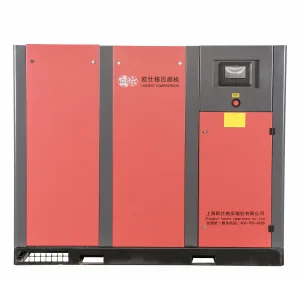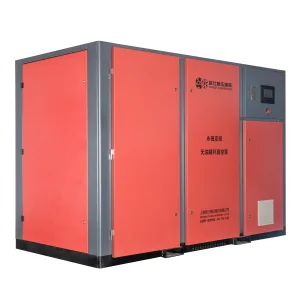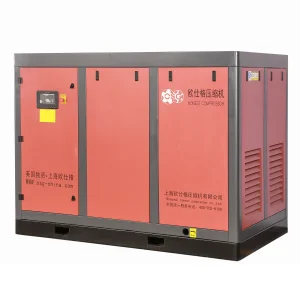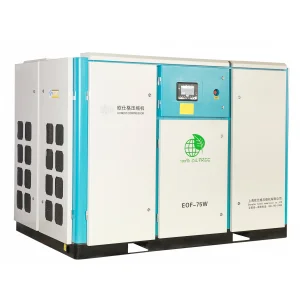
High-Efficiency Industrial Compressor Flagships
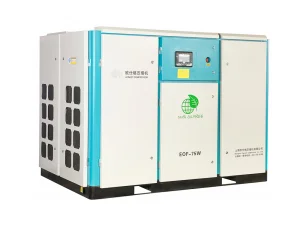
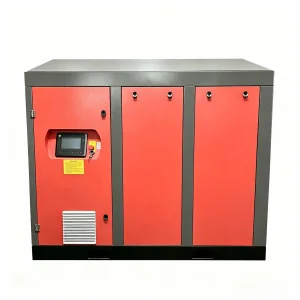
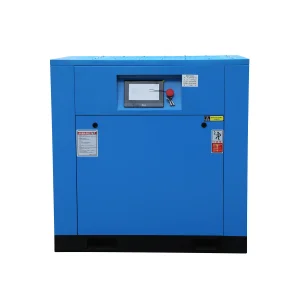

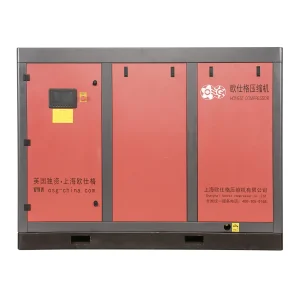
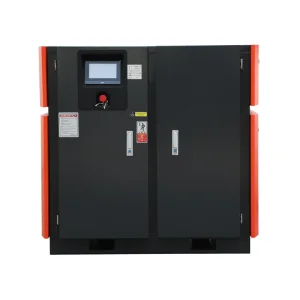
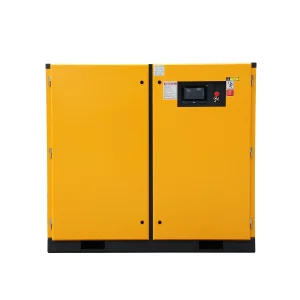
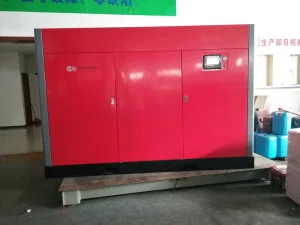
In the era of global industrial decarbonization and aggressive energy efficiency targets, compressed air systems represent both a critical utility and a major operational expense. Commonly referenced as the "Fourth Utility" in modern manufacturing plants, compressed air accounts for approximately 10% of total industrial electricity consumption worldwide. Among the diverse displacement technologies available, oil-flooded (oil-injected) rotary screw air compressors remain the dominant workhorse for continuous, heavy-duty industrial applications.
An oil-flooded screw compressor utilizes a precise volume of synthetic or mineral lubricant injected directly into the compression chamber during the rotation of helical male and female rotors. This injected fluid serves three essential thermodynamic functions: sealing internal rotor clearances to prevent back-leakage, lubricating anti-friction bearings, and most importantly, absorbing heat generated during compression to achieve near-isothermal compression efficiency.
As global procurement managers and Original Equipment Manufacturers (OEM) seek strategic partnerships with Original Design Manufacturers (ODM) in China, the key focus has shifted from capital expenditure (CAPEX) to Total Cost of Ownership (TCO). Energy costs account for roughly 75% to 80% of a heavy-duty industrial compressor's lifecycle cost over ten years. Therefore, partnering with engineering-led ODM oil flood air compressor factories that incorporate Advanced Rotor Profiles, Permanent Magnet Variable Speed Drives (PM-VSD), and smart IoT telemetry delivers a decisive competitive advantage in global export markets.
To achieve optimal Specific Power Consumption (measured in kW / (m³/min)), high-end ODM factories utilize advanced computational fluid dynamics (CFD) and finite element analysis (FEA) to perfect the asymmetric rotor profile. Modern oil-flooded rotary screw air compressors rely heavily on the 5:6 or 4:6 tooth profile, which maximizes volumetric displacement while minimizing the "blow-hole" cross-sectional area where pressurized air can leak back to the suction side.
State-of-the-art male and female rotors are ground using ultra-precision German CNC grinding machinery. The asymmetric 5:6 lobe configuration reduces internal pressure slip by up to 12% compared to traditional symmetric profiles, providing higher free air delivery (FAD) per shaft kilowatt.
Export-grade oil-flooded units integrate a triple-stage separation architecture: centrifugal knock-down, gravity settling, and high-efficiency borosilicate micro-glass filter element coalescing. This guarantees oil carryover levels well below 2 to 3 ppm, protecting downstream desiccant dryers and delicate pneumatic actuators.
By replacing standard induction motors with liquid-cooled or air-cooled Rare-Earth Permanent Magnet (PM) synchronous motors (IE4/IE5 efficiency rating), energy consumption drops dynamically across part-load operation. Unlike fixed-speed units that blow off excess air, PM-VSD systems match motor RPM directly to system air demand.
| Engineering Feature | Standard Single-Stage Oil-Flooded | Advanced Two-Stage Oil-Flooded (ODM Export Grade) |
|---|---|---|
| Pressure Ratio Distribution | Single ratio up to 1:13 in a single airend | Divided pressure ratio between Stage 1 & Stage 2 (e.g., 1:3.5 each) |
| Interstage Cooling | None (Thermal load borne entirely by oil injection) | Oil-curtain interstage cooling reduces gas volume entering Stage 2 |
| Volumetric Efficiency | 82% - 88% | 93% - 97% (Up to 15% energy reduction) |
| Bearing Mechanical Load | High radial and axial thrust on single shaft | Balanced load distribution doubles bearing rated service life (L10h) |
| Typical Enterprise Application | General workshop air, intermittent pneumatic operations | 24/7 continuous heavy duty (Chemical, Mining, Metal Laser Cutting) |
Deciphering global procurement queries reveals that international buyers—ranging from distributors in South America to plant engineering teams in Europe—search for specific engineering guarantees, compliance standards, and customization capabilities before placing bulk orders.
Global exporters must support custom electrical specifications: 380V/50Hz, 415V/50Hz, 220V/60Hz, 460V/60Hz, or 575V/60Hz. Leading ODM manufacturers provide UL, CSA, or CE compliant electrical cabinets featuring Schneider or Siemens contactors and dual-frequency inverter drives.
Industrial sites in the Middle East or Southeast Asia demand robust thermal dissipation. ODM factories optimize heavy-duty aluminum plate-fin oil coolers capable of continuous full-load operation in ambient environments reaching up to 50°C (122°F) without thermal tripping.
International distributors require white-label solutions: custom enclosure sheet metal colors, private-label touch-screen microcontrollers (supporting multi-language UI like English, Spanish, Russian, French), and integrated skid packaging (Compressor + Tank + Dryer).
Oil-flooded screw compressors are tailored to serve highly specialized industrial environments. Depending on working pressure (ranging from standard 7-10 bar up to high-pressure 16-25 bar systems), targeted ODM engineering delivers dedicated performance advantages.
Modern 10kW to 30kW fiber laser cutting machines utilize high-pressure compressed air as an auxiliary cutting gas instead of expensive liquid nitrogen. ODM factories manufacture specialized 16bar to 25bar integrated skid units with specialized high-pressure air-ends, delivering oil-free water-free air to ensure clean, burr-free sheet metal edges.
Continuous 24/7 processing plants require explosion-proof compliance (ATEX / Exd IIBT4), heavy-duty cast iron housing constructions, and corrosion-resistant stainless-steel piping. Dual-stage oil-flooded compressors guarantee process reliability with minimal maintenance downtime.
Automotive manufacturing lines suffer from rapidly shifting pneumatic loads due to robot arm cycles and stamping presses. Implementing PM-VSD oil-flooded compressors mitigates pressure spikes, stabilizes line air pressure, and lowers facility utility expenditure.
The future of industrial compressed air manufacturing lies at the intersection of mechanical precision and digital intelligence. ODM suppliers in China are rapidly transitioning from traditional equipment vendors to integrated smart solution providers.
By integrating IoT cloud telemetry gateways, real-time operating metrics—such as rotor vibration spectrums, oil discharge temperatures, motor current draws, and differential filter pressures—are continuously analyzed via AI algorithms. Predictive alerts notify operators before bearing fatigue or oil degradation causes catastrophic field failures.
The industry is rapidly phasing out belt-driven systems in favor of 1:1 direct-drive coupling and integrated shaft designs. Combining synchronous reluctance or oil-cooled permanent magnet motors directly with male rotor shafts eliminates transmission energy losses (2-3% savings) and reduces mechanical maintenance points.
Next-generation polyglycol (PAG) and polyolester (POE) synthetic lubricants extend fluid change intervals up to 8,000 to 10,000 operational hours while offering superior thermal oxidation resistance, preventing varnish buildup on screw rotors operating at high temperatures.
Exporting world-class compressed air machinery requires stringent manufacturing discipline, certified quality management systems, and comprehensive international compliance.
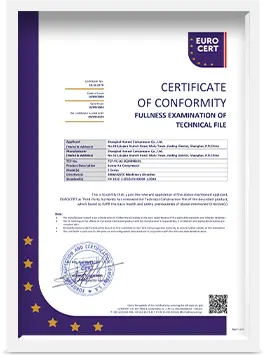
Top-tier Chinese ODM factories maintain full ISO 9001:2015 Quality Management System, ISO 14001:2015 Environmental Management, and ISO 45001 Occupational Health and Safety certifications. Pressure vessels integrated within oil separation tanks are built and hydrostatically tested in strict accordance with CE Simple Pressure Vessels Directive (2014/29/EU), PED (2014/68/EU), or ASME Code Section VIII Division 1 stamp standards.
100% of exported units undergo rigorous full-load run-in tests using automated nozzle testing rigs per ISO 1217 Annex C/E standards. Free Air Delivery (FAD), pressure, noise level (dB(A)), and specific energy consumption are documented in official inspection certificates prior to dispatch.
Machinery is treated with anti-corrosion barrier coatings, vacuum-sealed in moisture-proof foil packaging, and secured in heat-treated ISPM-15 compliant fumigation-free wooden crates designed to withstand long ocean transits and rough handling.
Expert answers to critical technical questions regarding oil-flooded rotary screw air compressors.
In an oil-flooded compressor, oil is directly injected into the rotor housing to seal, cool, and lubricate the rotors. The air comes into direct contact with oil, which is later removed down to <2-3 ppm via an oil separator. In contrast, oil-free screw compressors utilize timing gears to prevent rotor contact, and no oil enters the compression chamber, yielding ISO 8573-1 Class 0 air but at a significantly higher initial purchase cost and slightly lower thermodynamic efficiency.
Fixed-speed compressors run at a constant RPM. When demand drops, the unit unloads (idles), consuming about 30% of full power without producing compressed air. A PM-VSD compressor automatically adjusts motor RPM via an inverter to match exact air demand down to 25-30% of capacity, eliminating idling energy waste, keeping pressure constant within ±0.1 bar, and eliminating high-current star-delta starting peaks.
Standard preventive maintenance intervals include: replacing the intake air filter element and oil filter element every 2,000 to 3,000 hours; changing synthetic oil fluid every 4,000 to 8,000 hours (depending on oil formulation and operating temperature); and replacing the fine oil separator cartridge every 4,000 to 8,000 hours or when differential pressure exceeds 0.8 bar.
Two-stage compression divides the total pressure ratio between two separate rotor sets working in series. By cooling the air between stages (interstage oil curtain injection), compression work approaches isothermal ideal performance. This reduces internal compression heat, cuts leakage losses across rotor profiles, and yields 9% to 15% energy savings over single-stage machines of identical kW output.
Professional ODM exporters offer flexible OEM framework contracts. Customization options cover complete exterior sheet metal design, custom RAL powder coating, private-labeled micro-processor controllers, customized electrical panel components (e.g., ABB, Schneider, Siemens), tailored piping layouts, dual CE/UL certifications, and co-branded technical manuals.
Specialized ODM/OEM Compressors & Industrial Vacuum Solutions