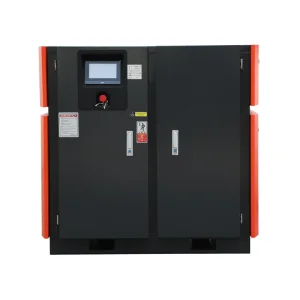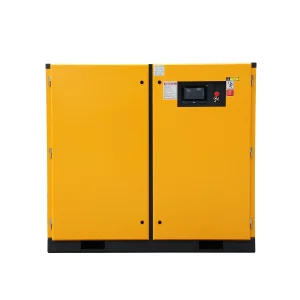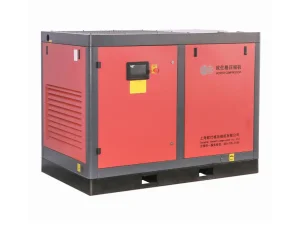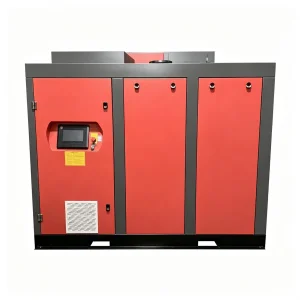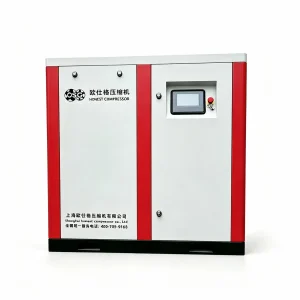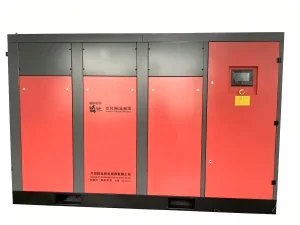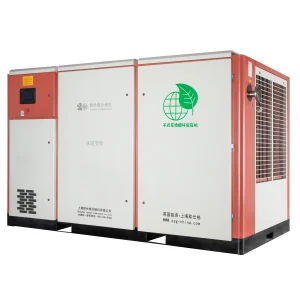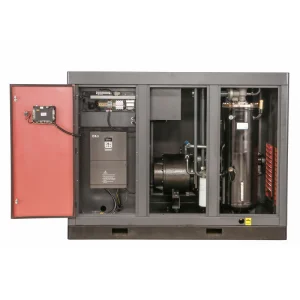
Featured Industrial Rotary Screw Systems
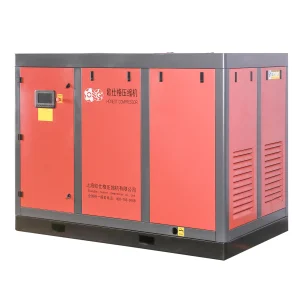
Precision-engineered compressed air and vacuum units designed for minimum kWh per cubic meter. Explore baseline models ready for turnkey global shipment or OEM custom specs.
Global Trends in Air Blower & Compressor Manufacturing
An executive overview of thermodynamic efficiency shifts, decarbonization mandates, and the engineering migration from legacy Roots technology to rotary screw blower architectures.
Thermodynamic Paradigm Shift
Industrial facilities worldwide are replacing conventional lobe-style Roots blowers with positive-displacement oil-free rotary screw blowers. By internalizing compression within optimized rotor profiles, screw blowers achieve adiabatic efficiencies up to 75–80%, delivering 20% to 35% net energy savings across continuous 24/7 operating cycles.
ISO 8573-1 Class 0 Mandates
Downstream applications in pharmaceuticals, electronics, food processing, and specialized chemical syntheses demand absolute contamination immunity. Modern OEM suppliers must guarantee zero aerosol or vaporized oil content, driving rapid adoption of dry-type and water-lubricated oil-free compression mechanisms.
VFD & Permanent Magnet Drives
Fixed-speed induction motors running unload cycles represent immense utility waste. The integration of IE4/IE5 ultra-premium efficiency Permanent Magnet Variable Frequency Drives (PM VFD) allows motor speeds to dynamically track mass flow requirements, maintaining linear power-to-flow ratios down to 25% turndown.
Deep-Dive Analysis: The Economics of Industrial Compressed Air
In mid-to-large-scale industrial plants, compressed air is often classified as the "fourth utility"—and for good reason. It consumes up to 10% of total industrial electricity globally. Over a standard 10-year operating horizon of an air compressor or blower, initial capital expenditure (CapEx) accounts for barely 10% to 15% of total ownership costs. Routine maintenance accounts for roughly 5% to 10%, while electrical consumption (OpEx) swallows an astounding 70% to 80% of total capital deployed.
Consequently, global procurement managers and chief engineering officers no longer evaluate OEM machinery purely on initial purchase price. The strategic procurement vector has irrevocably pivoted toward **Specific Energy Consumption (SER)**, measured in kilowatts per cubic meter per minute ($kW / (m^3/min)$). High-tier manufacturing facilities such as Shanghai Honest Compressor Co., Ltd. leverage advanced asymmetric twin-screw rotor geometry (such as 5:6 tooth ratios), direct-drive oil-cooled permanent magnet motors, and stage-matched intercooling to push energy metrics to physical thermodynamic boundaries.
Global Enterprise Procurement Demand & OEM Engineering Solutions
Navigating regional electrical grids, hazardous atmospheric classifications, and custom system-level integration for multi-national engineering procurement contracts (EPC).
1. OEM Voltage & Grid Frequency Adaptability
Factory buyers operating across North America, Europe, the Middle East, and Southeast Asia encounter vast electrical grid discrepancies. OEM custom offerings must support dual-frequency (50Hz / 60Hz) configurations and wide-band voltage windings including 220V, 380V, 400V, 415V, 440V, and 460V / 690V high-voltage platforms. Integrated variable frequency drives must possess built-in EMC/RFI filters and reactors to eliminate total harmonic distortion (THD) on sensitive factory networks.
2. Hazardous Zone & Explosion-Proof Customization
Chemical refineries, offshore platforms, and flour handling operations necessitate specialized skid packaging. Advanced OEM factories supply 4-in-1 integrated skid systems featuring Ex d IIB T4 / Ex d IIC T4 explosion-proof ratings. These enclose the air compressor unit, pressure receiver vessel, refrigerated or desiccant air dryer, and multi-stage coalescing filtration inside flameproof, IP65/IP66 enclosures designed for Zone 1 or Zone 2 hazardous deployments.
3. Smart Communication & Industry 4.0 Integration
Modern plant automation relies on real-time data telemetry. OEM machinery is outfitted with micro-processor PLC controllers supporting Modbus RTU, Profinet, EtherNet/IP, and CANopen industrial protocols. Continuous tracking of bearing vibration signature, air discharge temperatures, oil viscosity degradation, and differential filter pressure enables AI-driven predictive maintenance, preventing catastrophic unplanned downtime.
4. Tailored OEM/ODM Branding & Enclosure Engineering
Global brand owners and private-label distributors demand bespoke mechanical styling. Experienced production facilities offer custom sheet metal fabrication, RAL color matching, specialized acoustic insulation linings (yielding sound pressure levels down to 62–68 dB(A)), and customized physical footprints tailored to compact modular containerized power stations.
Macro Industrial Solutions & Sector-Specific Deployments
Matching pressure profiles, flow capacities (FAD), and air cleanliness ratings to mission-critical industrial process requirements.
Air blower compressors occupy a specialized performance envelope bridging low-pressure high-volume blowers (0.3 bar to 1.5 bar) and medium-to-high pressure standard industrial air compressors (3.0 bar to 13.0 bar). Selecting the optimal machine topology requires precise alignment between plant process physics and equipment aerodynamic maps.
Wastewater Aeration
Biological treatment basins in municipal and industrial wastewater facilities require continuous, non-pulsating low-pressure air (0.4–1.1 bar). Oil-free screw blowers featuring VFD PM motor integration maintain precise dissolved oxygen (DO) setpoints in aeration tanks, eliminating over-aeration electrical waste and surviving harsh ambient conditions.
Pneumatic Conveying
Dilute and dense phase pneumatic conveying of bulk powders—such as cement, plastic pellets, fly ash, and food grains—relies on steady air velocity to prevent line plugging. Two-stage and oil-free screw blower compressors eliminate lubricant contamination of conveyed media while delivering consistent discharge pressure.
Chemical & Petrochemical
Continuous gas agitation, oxidation reactions, and hazardous instrument air mandate extreme operational reliability. Two-stage oil-cooled and dry-type screw compressors up to 250 kW offer inter-stage cooling, significantly lowering compression heat, thermal stress on seals, and overall risk of volatile organic compound (VOC) combustion.
Technology Roadmap & Next-Generation Innovations
How emerging materials, magnetic levitation, water-lubrication physics, and artificial intelligence are redefining rotary compressor design over the next decade.
1. Water-Lubricated Single & Twin Screw Architecture
Traditional oil-injected compressors utilize specialized synthetic oils for sealing, cooling, and lubricating rotor intermesh points. However, oil separation systems are subject to mechanical failure and filtration carry-over. Water-lubricated oil-free screw compressors utilize purified water injected directly into the compression chamber. Water boasts a specific heat capacity roughly four times greater than standard compressor oil ($4.184 \, J/g^\circ C$ vs. $\sim 2.0 \, J/g^\circ C$), resulting in near-isothermal compression profiles ($T_{discharge} < 50^\circ C$). This drastically reduces mechanical thermal expansion, eliminates oil maintenance consumables, and guarantees 100% Class 0 compliance.
2. High-Speed Mag-Lev Direct Drive Turbo Integration
For large-volume low-pressure blower installations, magnetic levitation (Mag-Lev) bearing assemblies coupled to high-speed permanent magnet synchronous motors (PMSM) represent the pinnacle of dynamic efficiency. By suspending the rotating shaft in a non-contact electromagnetic field, mechanical friction losses drop to zero. Rotating speeds exceeding 30,000 RPM are achieved without mechanical wear or grease lubrication, extending unit overhaul intervals to over 100,000 operational hours while eliminating mechanical vibration signatures.
3. Advanced Rotor Profile Design Optimization
The efficiency of a rotary screw compressor is fundamentally governed by the blow-hole area formed between male and female rotor lobes. Modern CNC rotor grinding machines utilizing cubic boron nitride (CBN) tooling allow production tolerances within $\pm 1.5 \, \mu m$. OEM manufacturers are transitioning from conventional symmetrical profiles to 5:6 and 6:7 asymmetric patent profiles. These minimize internal gas back-leakage from high-pressure discharge ports back to low-pressure suction ports, boosting volumetric yield by up to 8% per revolution.
4. Autonomous Edge-AI & Fleet Digital Twin Controllers
Future industrial plant air networks will operate as self-optimizing energy micro-grids. Built-in edge computing modules aggregate real-time data streams across pressure, temperature, current drawdown, dew point, and ultrasonic leak sensors. Machine learning algorithms construct dynamic digital twin models of compressed air networks, predicting peak demand loads and dynamically modulating VFD motor speeds across multi-compressor sequencing arrays to ensure the station operates strictly at the minimum thermodynamic energy baseline.
Localization Support & Global Quality Compliance
Bridging high-precision British-engineered design heritage with Shanghai's world-class automated manufacturing infrastructure.
British Engineering Standards in Shanghai Hub
Shanghai Honest Compressor Co., Ltd., established as a British-owned enterprise in early 2004, operates a modern 50,000 m² smart manufacturing facility in Jiading District, Shanghai. By combining rigorous Western design codes with highly agile, automated domestic component supply chains, the factory achieves an exceptional balance of mechanical longevity, thermal endurance, and competitive capital expenditure.
Every compressor unit leaves the assembly floor subject to full-load factory acceptance testing (FAT) under simulated ambient extremes. Digital performance logs record flow capacity (FAD), electrical consumption, noise emission levels, vibration velocity, and pressure stability against ISO 1217 Annex C/E standards.
International Regulatory Compliance Matrix
-
✓ISO 9001:2015 & ISO 14001: Certified Quality Management and Environmental Safety Systems governing all manufacturing and testing protocols.
-
✓European CE Conformance (PED 2014/68/EU): Full pressure equipment directive compliance for export into European Union territories.
-
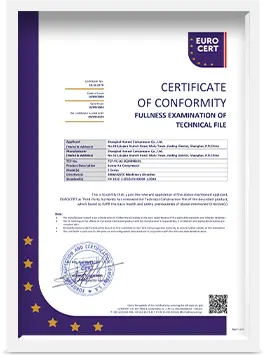
✓ISO 8573-1 Class 0 Certification: Verified zero oil content validation tested by third-party international laboratories (TÜV).
-
✓ASME / DOSH / CRN Pressure Vessel Compliance: Pressure receivers welded and certified to international regional safety codes.
Frequently Asked Questions (Buyer Q&A)
Addressing essential technical, contractual, and operational questions asked by plant managers, EPC contractors, and OEM buyers.
- Free Air Delivery (FAD): Flow required in $m^3/min$, $CFM$, or $Nm^3/h$.
- Operating Working Pressure: Bar, PSI, or MPa.
- Air Purity Standard: ISO 8573-1 Class rating required (Class 0 oil-free vs. oil-injected).
- Electrical Grid Specifications: Voltage (e.g., 380V/400V/460V), Frequency (50Hz/60Hz), and Phase.
- Environmental Conditions: Ambient temperature range, altitude, and humidity levels.
High-Capacity & Special Purpose Air Machinery
Two-stage compressors, low-noise VFD systems, dry-screw oil-free units, and vacuum pumps engineered for critical industrial applications.