Industrial Rotary Screw Compressor Portfolio
Precision-engineered compressed air systems manufactured for maximum energy efficiency, severe duty operational cycles, and strict environmental compliance.
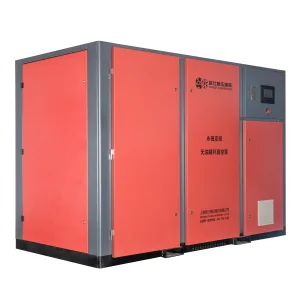
State of Rotary Compression Thermodynamics & Total Cost Economics
An engineering breakdown of modern volumetric positive-displacement rotary screw technology, thermodynamic optimization, and life-cycle financial modeling.
In modern process industries and advanced automated manufacturing, compressed air is universally recognized as the fourth industrial utility alongside water, electricity, and natural gas. However, unlike traditional utilities, compressed air is inherently energy-intensive: approximately 80% to 90% of electrical energy consumed by a conventional air compressor is converted into low-grade thermal waste, with only 10% to 20% transferred into actual pneumatic kinetic potential. As global industrial plants transition toward Net-Zero carbon mandates and aggressive ESG (Environmental, Social, and Governance) benchmark goals, selecting highly efficient rotary compressor machinery from established Original Equipment Manufacturers (OEM) has moved from a routine procurement decision to a strategic engineering imperative.
Thermodynamic Fundamentals: Rotary Twin-Screw Rotor Profiles
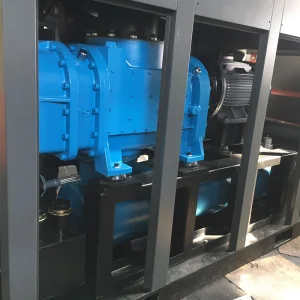
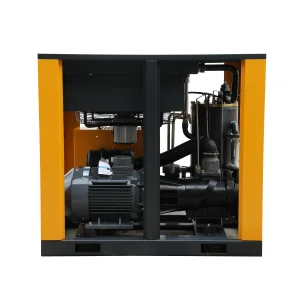
The operational core of a highly efficient rotary screw compressor relies on the precise intermeshing of asymmetric helical rotors (typically featuring a 5:6 or 4:6 male-to-female lobe geometry). As the male rotor driven by the prime mover rotates, it seals the volumetric pocket between the casing and the female rotor, progressively decreasing the pocket volume along the longitudinal axial axis. This continuous positive displacement mechanism compresses gas without the pressure pulsation, mechanical valve friction, or high vibration inherent to reciprocating piston designs.
Thermodynamically, near-isothermal compression delivers maximum volumetric and specific efficiency. Heat generated during compression elevates gas pressure but degrades overall compression efficiency. OEM highly rotary compressor engineering mitigates dynamic thermal rise using two distinct technical methodologies:
- Fluid Injected Synthetic Lubrication: Fluid injected into the compression chamber performs triple duties—heat absorption (thermal sink), rotor sealing, and mechanical lubrication. Advanced oil-cooled PM VFD compressors maintain precise internal discharge temperatures (typically 80°C to 95°C), preventing condensation while maintaining maximum air mass density.
- Two-Stage Compression with Inter-Stage Cooling: By splitting the total pressure ratio across two distinct low-pressure and high-pressure rotor stages, inter-stage cooling drops intake temperatures for the second stage. This reduces internal compression work requirements by 10% to 15% compared to single-stage equivalents handling identical flow capacities.
SEC (kW / (m³/min)) = Total Electrical Input Power (kW) ÷ Free Air Delivery (FAD in m³/min)
A reduction of just 0.5 kW/(m³/min) in SEC for a 250kW continuous-duty air compressor yields over $18,000 USD in direct electrical utility savings per annum under standard continuous multi-shift operations ($0.12/kWh).
Global Enterprise Sourcing & Procurement Drivers
Strategic criteria utilized by Fortune 500 procurement teams, plant engineering leadership, and international EPC firms when selecting OEM manufacturing partners.
Total Cost of Ownership (TCO)
Initial machinery capital expenditure (CAPEX) represents only 10% to 15% of total system expenditure over a standard 10-year operating life. Maintenance accounts for 7%, while electricity consumption (OPEX) demands 78%+. Procurement managers prioritize high-efficiency VFD and two-stage architectures to minimize lifecycle TCO.
Custom OEM Architecture
Global plants demand regional electrical adaptability: multi-voltage configurations (220V/380V/400V/415V/460V at 50Hz/60Hz), custom enclosure ingress ratings (IP55/IP66), localized controller UI languages, and explosion-proof certifications (ATEX / Ex d IIB T4 / Ex d IIC T4) for hazardous environments.
Modular Supply Chain Security
Enterprise buyers avoid proprietary lock-ins. OEM factories providing standardized, high-grade consumable components (air filters, oil separators, synthetic coolants, and standardized PLC controllers with Modbus RTU / CANbus) ensure rapid localized serviceability and zero production downtime risk.
Macro Industry Solutions & Application Vectors
Tailored gas compression and airflow delivery systems specified to handle exact physical requirements across distinct industrial sectors.
High-Pressure Laser Cutting (16 - 30 bar)
Precision sheet metal fiber laser cutting relies heavily on high-pressure compressed air as an auxiliary assist gas to blow away molten slag and clean oxidation edges. High-pressure 20bar/30bar integrated screw compressors deliver ultra-dry air with integrated multi-stage filtration down to 0.01 micron, replacing expensive liquid nitrogen.
Chemical, Oil & Gas Hazardous Zones
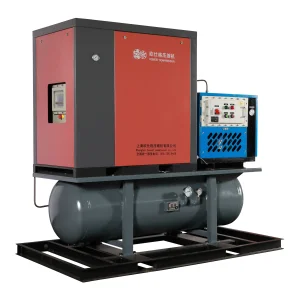
Petrochemical plants and offshore platforms demand strict flameproof and explosion-proof compliance. OEM 4-in-1 explosion-proof integrated air compressors (7.5-22kW) house flameproof motors (Ex d IIB/IIC T4), anti-spark electrical control enclosures, and pressurized vessel receivers designed under ASME / CE-PED standards.
Pharma, Food & Semiconductor Cleanrooms
Zero contamination risk is mandatory where compressed air comes into direct contact with products. OEM dry oil-free and water-lubricated rotary screw compressors eliminate synthetic oil from the compression chamber, ensuring strict ISO 8573-1 Class 0 pure certified air delivery for sterile manufacturing.
Technological Roadmap & Engineering Outlook
Advanced motor dynamics, material science, and digital IoT intelligence driving the next era of industrial rotary compressor machinery.
1. Ultra-Efficient IE4/IE5 Permanent Magnet VFD Integration
Traditional induction motors suffer from continuous excitation electrical losses, rotor slip friction, and drastically reduced efficiency curves under low-load conditions. Next-generation OEM rotary compressors utilize IE4 and IE5 super-premium efficiency Permanent Magnet (PM) synchronous motors. Utilizing high-coercivity NdFeB (Neodymium Iron Boron) permanent magnets, these drive systems maintain up to 96% to 97% motor efficiency even when operating at 20% partial load capacity.
Furthermore, oil-cooled PM motor designs eliminate external cooling fan energy overhead. By circulating internal compressor oil directly through the motor jacket casing, motor operating temperatures are suppressed, magnet demagnetization risk is eliminated, and motor frame sizes are reduced by up to 50% for compact integrated footprints.
2. Water-Lubricated Single & Twin Screw Technology
Water-lubricated oil-free rotary screw compressors represent a quantum step forward in pure air delivery. Instead of synthetic lubricating oil, pure purified water is injected directly into the compression chamber. Water possesses a specific heat capacity approximately 2.5 times higher than standard compressor oil, achieving exceptional thermodynamic cooling and keeping compression nearly isothermal (discharge temperatures stay strictly below 45°C to 50°C).
Engineering challenges regarding corrosion and material wear are solved via advanced composite engineering: rotors crafted from high-precision ceramic materials or specialized stainless steel alloys, paired with PEEK (Polyether Ether Ketone) polymer bearing seals.
3. IoT Edge Intelligence & Predictive Industry 4.0 Maintenance
Modern highly rotary compressor factories integrate advanced microprocessor controllers featuring real-time diagnostic telemetry. Standard features include:
- Dynamic FFT Vibration Analysis: Continuous monitoring of rotor dynamic balancing to detect early bearing fatigue or gear backlash prior to catastrophic equipment failure.
- Thermal Profile Trending: Real-time tracking of intake temperature, inter-stage pressure, oil line differential pressure, and pressure dew point.
- Automated VFD Vector Modulation: Algorithmic modulation of motor speed (RPM) precisely following plant line pressure fluctuations within ±0.01 MPa, eliminating wasted load/unload power cycles.
Industrial Compression Technology Benchmark
Comparative evaluation of primary industrial compressed air machinery across operational parameters, investment thresholds, and suitability profiles.
| Performance Metric | OEM PM VFD Screw Compressor | Two-Stage Heavy Screw | Water-Lubricated Oil-Free | Standard Piston / Reciprocating |
|---|---|---|---|---|
| Efficiency (SEC) | Excellent (5.8 - 6.4 kW/m³/min) | Superior (< 5.5 kW/m³/min) | High (6.2 - 6.8 kW/m³/min) | Poor (> 8.0 kW/m³/min) |
| Pressure Stability | ±0.01 MPa (Constant) | ±0.02 MPa | ±0.01 MPa | High Fluctuation (±0.1 MPa) |
| Air Quality Purity | Industrial Grade (1-3 ppm oil) | Industrial Heavy Duty | ISO 8573-1 Class 0 (100% Pure) | Heavy Oil Contamination |
| Duty Cycle Rating | 100% Continuous 24/7 | 100% Heavy Industrial 24/7 | 100% Continuous Cleanroom | Intermittent (60% Max Duty) |
| Acoustic Noise Level | 62 - 68 dB(A) Low Noise | 68 - 74 dB(A) Quiet Enclosed | 60 - 65 dB(A) Ultra Quiet | 85 - 100+ dB(A) High Vibration |
| 10-Year TCO Rating | Lowest Overall TCO | Optimal for Base-Load >200kW | Lowest Risk for Clean Sector | Highest TCO due to Power Draw |
Localization Support & Compliance Assurance
Engineering customization and international safety standards compliance designed for seamless import clearance and factory site integration.
International Directives & Approvals
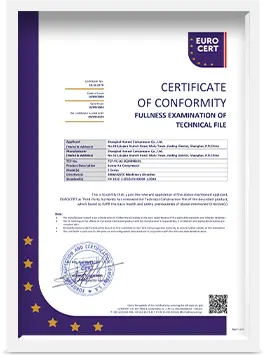
Fully compliant with European CE Directives (Machinery Directive 2006/42/EC, Pressure Equipment Directive PED 2014/68/EU, Electromagnetic Compatibility EMC 2014/30/EU). Pressure vessels engineered to ASME, CE-PED, or GB standards based on destination market custom clearance criteria.
Electrical & Climate Adaptation
Engineered to operate reliably under extreme ambient temperatures (-20°C up to +50°C tropicalization packages). Power configurations modified at the factory level for North America (460V/60Hz), Europe (400V/50Hz), UK/Asia (415V/380V), and South America (220V/60Hz 3-Phase or Single Phase).
Multilingual Smart Touch Controllers
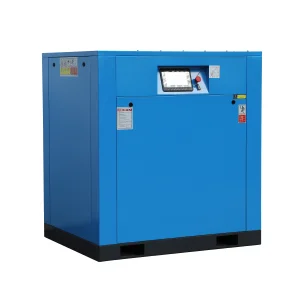
Color touchscreen micro-computer PLC controllers installed with multi-language interface options (English, Spanish, Russian, French, German, Arabic, Chinese). Features remote monitoring via IoT cloud apps, RS485 Modbus networking, and multi-compressor sequencing capabilities.
Advanced Custom Systems & Special Applications
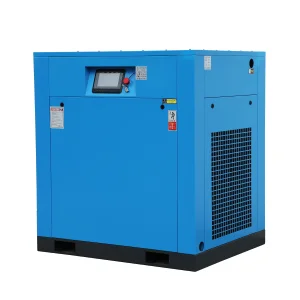
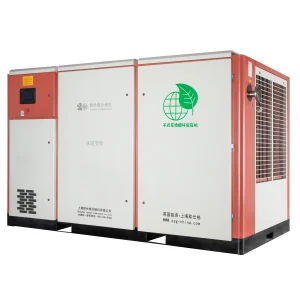
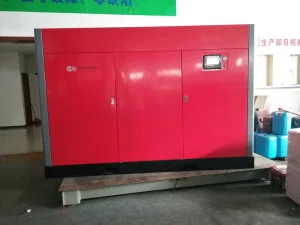
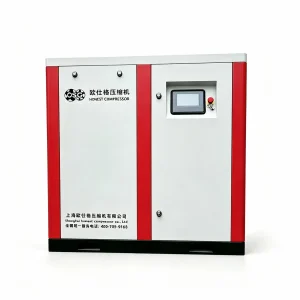
High-efficiency single-phase, two-stage, oil-cooled, and water-lubricated rotary screw machinery designed for custom industrial orders.
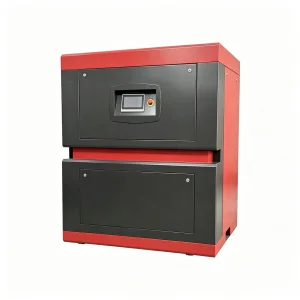
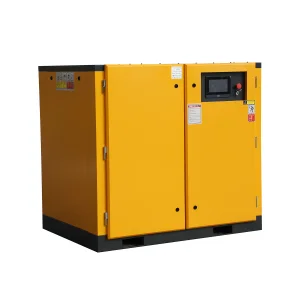
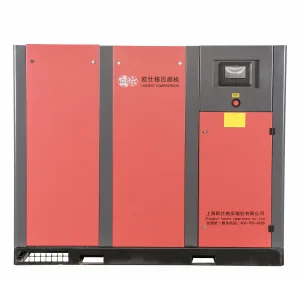

Frequently Asked Engineering & Procurement Questions
Detailed answers regarding technical specifications, sizing, energy audits, and OEM customization.
How does Permanent Magnet Variable Frequency Drive (PM VFD) achieve up to 40% energy savings?
In standard fixed-speed air compressors, when factory compressed air consumption fluctuates, the compressor shifts into an "unload" state: the motor continues running at full RPM speed while idling, consuming roughly 30% to 40% of full-load power while producing zero air output. PM VFD compressors eliminate idling power waste entirely by utilizing vector frequency inverter controls that precisely adjust the motor rotation speed (RPM) to match real-time compressed air demand. When air demand drops, motor speed ramps down proportionally, decreasing power draw linearly. Furthermore, Permanent Magnet (IE4/IE5) motors do not experience rotor excitation losses, retaining high thermal efficiency across the entire variable frequency range.
What is the technical difference between Dry Type Oil-Free and Water-Lubricated Oil-Free Screw Compressors?
Both systems deliver ISO 8573-1 Class 0 oil-free certified air, but rely on different thermodynamic mechanics:
- Dry Type Oil-Free: Operates without any liquid in the compression chamber. Due to high compression temperatures, dry type units require a two-stage rotor configuration with intercoolers, special rotor surface coatings (such as PTFE/Ultra-coat), and precision timing gears to maintain non-contacting rotor clearances. Operating costs are higher, but zero liquid is injected.
- Water-Lubricated Oil-Free: Injects purified water into a single-stage compression chamber. The water acts as a natural seal, lubricant, and cooling agent, maintaining near-isothermal compression (discharge temperature < 50°C). This allows high single-stage pressure ratios at lower motor RPMs, offering a lower initial CAPEX and simplified mechanical maintenance.
When should an enterprise buyer specify a Two-Stage Screw Compressor over a Single-Stage unit?
Two-Stage compression is highly recommended for continuous, heavy-duty industrial facilities operating motor power ratings of 55kW (75HP) up to 315kW+ with stable high-volume air demands. By dividing the compression pressure ratio (e.g., 0.8 MPa total pressure split into Stage 1 at 0.22 MPa and Stage 2 at 0.8 MPa) with inter-stage cooling, internal rotor leakage is reduced, thermal strain is minimized, and dynamic bearing loads drop significantly. Two-stage compressors consume 10% to 15% less specific power (kW/m³/min) than equivalent single-stage machines under identical operating pressures.
What engineering parameters are required when requesting an OEM custom factory quotation?
To ensure precise engineering sizing and tailored OEM component selection, provide the following operational parameters:
- Free Air Delivery (FAD) Flow Rate: Measured in m³/min, CFM, or L/sec.
- Target Operating Working Pressure: Measured in bar, MPa, or PSI (e.g., 7 bar, 8 bar, 13 bar, 20 bar).
- Site Electrical Supply: Voltage (V), Frequency (50Hz or 60Hz), and Phase count (3-Phase or Single-Phase).
- Air Quality Purity Class Requirements: General industrial pneumatic grade vs ISO Class 0 pure cleanroom air.
- Environmental Conditions: Ambient installation temperature range, ambient altitude, dust level, or hazardous explosion-proof zone classifications (ATEX / Zone 1 / Zone 2).
What routine preventive maintenance is required to maintain peak rotary screw efficiency?
Routine service intervals depend on site operating hours and atmospheric cleanlines. Standard guidelines for oil-injected rotary screw compressors include:
- Air Intake Filter Element: Inspect/clean monthly; replace every 2,000 to 3,000 operating hours.
- Oil Filter Element: Initial replacement at 500 hours; subsequent replacements every 2,000 to 3,000 hours.
- Air/Oil Separator Cartridge: Replace every 4,000 to 6,000 operating hours or when differential pressure exceeds 0.08 MPa.
- Synthetic Rotary Coolant/Oil: Sample periodically; full oil change every 4,000 to 8,000 operating hours based on synthetic fluid grade.