Featured 50 HP & High-Efficiency Industrial Compressors
Precision-engineered continuous-duty rotary air compressors, dry screw vacuum pumps, and permanent-magnet systems configured for international heavy manufacturing.
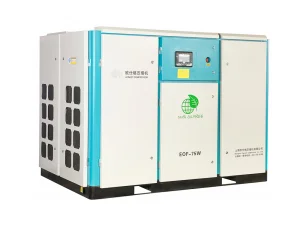
China 55kw to 315kw Oil free screw air compressor with dry type fixed speed or VSD PM type Suppliers, Exporters
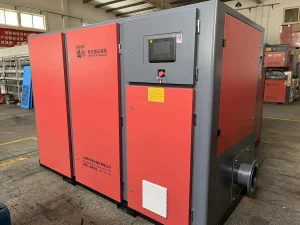
China 30kw Industrial Oil Free Vsd Screw Air Blower Vacuum Pump With Plc Inverter Pm Motor oil free screw blower Supplier, Suppliers
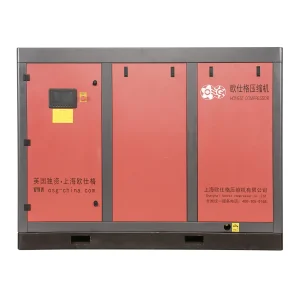
China 55KW 75HP 7-13bar air compressor two stage screw air compressor Direct Drive Screw Type Compressors with VSD PM motor and Inverter Factory, Factories
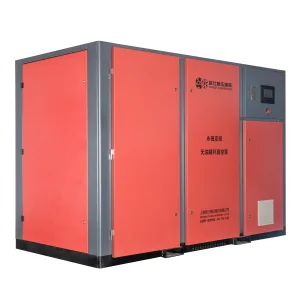
ODM PM VFD Dry Oil-Free Screw Vacuum Pump for Industrial Clean Vacuum Manufacturer, Suppliers
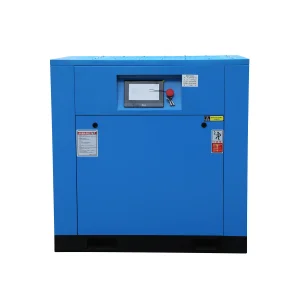
OEM Industrial 15kw/22kw/37kw/55kw/75kw Energy Saving Pm Motor VSD/VFD Rotary Screw Air Compressor Manufacturer, Exporters
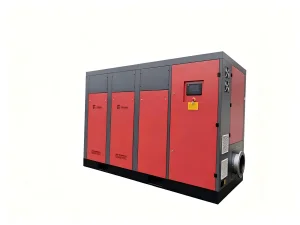
ODM Industrial Screw Vacuum Pump Oil Free High Efficiency Vacuum Pump for Semiconductor & Chemical Industry Manufacturer, Factories
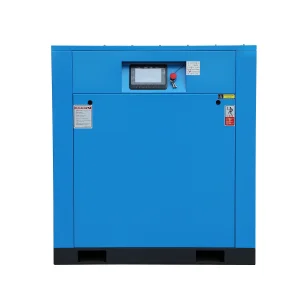
OEM VFD screw air compressor 0.7-1.25mpa Energy Saving up to 30% Manufacturers, Exporter
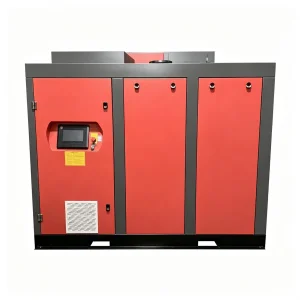
OEM Hot Sale China Factory High Quality Screw Vacuum Pump Permanent Magnet Frequency Conversion Progressive Pump Manufacturers, Factories
The 50 HP (37 kW) Rotary Screw Compressor in Modern Global Industry
An authoritative analysis of industrial air demand, supply chain consolidation, thermodynamic engineering, and total life-cycle economics across international manufacturing corridors.
The Workhorse of Global Fabrication
In modern industrial automation, the 50 Horsepower (37 kW) displacement tier represents the foundational power bracket for medium-to-large automated facilities. Operating within an air delivery window of 5.6 to 6.8 m³/min (198 to 240 CFM) at standard working pressures from 7 to 13 bar (0.7 to 1.3 MPa), the 50 HP compressor supplies the exact dynamic pneumatic equilibrium needed for laser cutting gantries, robotic paint sprayers, high-cadence packaging cells, and chemical reactor instrumentation.
Thermodynamic & Life-Cycle Shifts
Historically, global industrial installations absorbed enormous operating expenditure penalties through fixed-speed mechanical load/unload cycles. Over a standard 10-year lifespan (equating to roughly 60,000 running hours), electricity expenditure constitutes between 75% and 82% of the overall Total Cost of Ownership (TCO). Chinese tier-one original equipment manufacturers (OEMs) have altered this economic paradigm by engineering advanced Permanent Magnet Variable Frequency Drive (PM VFD) packages directly into standard 37 kW architectures.
Supply Ecosystem Consolidation
The Yangtze River Delta, anchored by industrial hubs in Jiading, Shanghai and surrounding provinces, has established the world's most concentrated cluster for air end precision rotor grinding, synchronized variable-frequency controller manufacturing, and automated ASME/CE pressure vessel welding. As British-invested and precision-managed manufacturing centers unite European thermodynamic profile geometries with China's rapid precision casting infrastructure, international buyers secure machinery that meets rigid Western operational criteria at an unmatched performance-to-capital ratio.
Engineering Principles of 50 HP Screw Compressors
Dissecting the internal kinematics, rotor profiling, aerodynamic compression cycles, and thermal equilibrium loops within premier Chinese manufacturing lines.
1. Asymmetrical Rotor Geometries (5:6 vs 4:6 Profile)
The mechanical core of any high-yield 50 HP compressor rests upon its screw airend. Contemporary Chinese precision manufacturers employ finite-element-analyzed 5:6 asymmetrical tooth profiles crafted from forged carbon-alloy steel (such as 40Cr or 42CrMo). The 5-lobe male driver rotor meshes smoothly with the 6-flute female driven rotor, generating a continuous seal-line contour that shrinks blow-hole area by up to 40% compared to legacy 4:6 symmetrical designs.
By limiting inter-lobe air leakage across pressure deltas up to 1.3 MPa, the volumetric displacement efficiency exceeds 95%. Rotor pairings undergo sub-micron dimensional verification on Zeiss coordinate measuring machines (CMM) before paired assembly into heavy-ribbed cast iron housings fitted with precision SKF Explorer or NSK cylindrical roller and angular-contact ball bearings.
2. Rare-Earth PM Synchronous Motors (NdFeB High-Flux)
Standard induction motors suffer rotor copper losses that diminish efficiency sharply when operated below 70% of nominal loading. Leading Shanghai manufacturing facilities circumvent this using Neodymium-Iron-Boron (NdFeB) permanent-magnet synchronous motors (PMSM). These specialized drive units eliminate internal magnetic excitation losses entirely, maintaining an IE4 (Super Premium) or IE5 (Ultra Premium) efficiency curve from 25% up to 100% rated operational speeds.
With Class F or H insulation, IP65 ingress encasement, and high-coercivity magnets capable of enduring 180°C continuous temperatures without thermal demagnetization, PMSM powertrains reduce parasitic electrical draw by 9% to 15% directly at the shaft coupling over equivalent induction-motor competitors.
3. Single-Stage vs Two-Stage Compression Thermodynamic Yield
When operating a 50 HP compressor continuously under heavy industrial loads (6,000+ hours per year), specifying a two-stage rotary screw configuration offers definitive thermodynamic advantages. Single-stage compression forces air across a 1:8 or 1:10 pressure ratio in a single chamber, yielding discharge temperatures near 90°C–95°C and increasing gas re-expansion losses.
Conversely, two-stage systems partition the overall pressure ratio evenly across two distinct rotor stages (e.g., stage 1 brings atmospheric air to 0.3 MPa; stage 2 brings it to 0.8–1.0 MPa). An oil-curtain intercooling mist injected between stages drops intermediate air temperatures, bringing the compression cycle closer to an ideal, isothermal process. This dual-stage thermodynamic optimization reduces specific power consumption by 12% to 18% per cubic meter delivered.
4. Oil-Injected vs Oil-Free Dry Screw Engineering
For general industrial tooling, metal fabrication, and pneumatic automation, oil-injected rotary screw systems remain the global standard due to synthetic lubrication that cools the compression pocket, seals rotor clearances, and cushions bearing race loads. In modern factories, high-efficiency cyclonic separator vessels with triple-stage coalescing filters guarantee residual oil carry-over below 2–3 ppm.
For sensitive manufacturing ecosystems—including pharmaceuticals, bioprocessing, food packaging, semiconductor cleanrooms, and high-grade optics—Chinese tier-one factories manufacture dry screw or water-lubricated oil-free compressors. By isolating lubricating oil from the compression chambers via dual vented carbon ring seals and atmospheric labyrinth gaps, these 50 HP systems earn verified ISO 8573-1 Class 0 certification, guaranteeing zero trace hydrocarbons.
| Architecture Typology | Motor Power (kW/HP) | Working Pressure (bar) | Flow Volume (m³/min) | Specific Power (kW/m³/min) | ISO 8573-1 Air Quality Class |
|---|---|---|---|---|---|
| 50 HP Single-Stage PM VFD (Oil-Injected) | 37 kW / 50 HP | 7.0 - 8.5 bar | 6.20 - 6.65 m³/min | 6.12 - 6.35 kW/m³/min | Class 2 (Oil: ≤ 2 ppm) |
| 50 HP Two-Stage Integrated PM VFD | 37 kW / 50 HP | 7.0 - 10.0 bar | 6.85 - 7.15 m³/min | 5.35 - 5.65 kW/m³/min | Class 2 (Oil: ≤ 1 ppm) |
| 50 HP Water-Lubricated Single Screw | 37 kW / 50 HP | 7.0 - 10.5 bar | 5.70 - 6.10 m³/min | 6.50 - 6.80 kW/m³/min | Class 0 (100% Oil-Free) |
| 50 HP Dry-Type Two-Stage Screw | 37 kW / 50 HP | 7.0 - 10.0 bar | 5.40 - 5.85 m³/min | 6.90 - 7.30 kW/m³/min | Class 0 (100% Oil-Free) |
| 50 HP High-Pressure Specialized (Laser Cutting) | 37 kW / 50 HP | 13.0 - 16.0 bar | 4.50 - 4.90 m³/min | 7.80 - 8.20 kW/m³/min | Class 1 (Particulate & Moisture Tuned) |
Localized Support Infrastructure & Global Compliance Assurance
Mitigating importation, certification, electrical synchronization, and cross-border maintenance risks for plant managers across North America, the EU, Southeast Asia, and the Middle East.
Pressure Vessel & Safety Directives
Exporting industrial machinery demands rigorous adherence to regional pressure boundary laws. Reliable Chinese compressor exporters manufacture air-oil separator vessels and heat exchangers compliant with the European Pressure Equipment Directive (PED 2014/68/EU), CE Machinery Directives (2006/42/EC), and the American Society of Mechanical Engineers (ASME Boiler and Pressure Vessel Code Section VIII Div 1, complete with U-stamp registration). Every certified vessel is subjected to 1.5x hydrostatic proof testing with certified non-destructive x-ray weld examination.
Harmonic Filtering & Grid Conformity
Variable frequency drives can introduce destructive Total Harmonic Distortion (THD) into plant electrical switchboards if left unmanaged. Premier export builds incorporate built-in DC chokes or line reactors (3% to 5% impedance) and integrated EMC filters conforming to EN 61800-3 Category C2/C3. The control hardware natively adapts across 380V/50Hz, 400V/50Hz, 460V/60Hz, 480V/60Hz, and 220V/60Hz electrical infrastructures, ensuring seamless hookup without requiring expensive off-site step-down transformers.
Consumables & Local Serviceability
A primary concern for international equipment buyers is ongoing spare parts availability. Trusted Chinese export hubs utilize standardized spin-on oil filters, air filter cartridges, and spin-on separator canisters cross-compatible with universal Mann-Hummel, Donaldson, or Parker filtration dimensions. By choosing universal dimensional standards rather than closed proprietary lock-outs, international maintenance technicians can procure replacement media through domestic supply houses in under 24 hours.
Modern Chinese facilities provide structured two-year warranties on the rotor airend, accompanied by direct 4G/5G IoT telemetric edge modules. Factory service engineers in Shanghai can query operating pressures, inverter carrier frequencies, bearing vibration amplitudes, and thermal deltas in real-time alongside local on-site technicians, expediting root-cause troubleshooting without costly cross-continental field service visits.
Real-World Application Scenarios for 50 HP Air Systems
Strategic pneumatics integration across advanced high-demand industrial sectors requiring continuous uptime and dynamic pressure regulation.
Fiber Laser Cutting & Sheet Metal
Industrial fiber lasers (6 kW to 20 kW optical output) increasingly replace liquid nitrogen assist gas with high-pressure clean compressed air (16 bar, ISO Class 1:2:1) for carbon steel and aluminum processing. A 50 HP high-pressure PM VFD screw compressor combined with high-performance refrigerated and desiccant drying columns delivers dry, pressurized air at a fraction of bulk liquid nitrogen costs, reducing per-part cutting overhead by up to 70%.
Automotive Stamping & Robotic Paint Lines
High-speed hydraulic press feed tables, pneumatic sheet separation magnets, and robotic multi-axis electro-pneumatic paint atomizers demand unwavering pressure stability within ±0.01 MPa. The high-speed PID control loop of a 50 HP PM VFD compressor constantly modulates rotor velocity to neutralize pressure drops caused by simultaneous pneumatic actuator cycles, preventing surface defects in automated painting booths.
Food, Beverage & Aseptic Packaging
Form-fill-seal equipment, pneumatic liquid dosing pumps, and blow-molding operations require air free from oil vapors and moisture. Deploying a 50 HP water-lubricated or dry-type oil-free compressor ensures that clean air contacts milk cartons, beverage bottles, or pharmaceutical blister packs directly, eliminating microbiological risks and guaranteeing compliance with strict HACCP and FDA cGMP criteria.
Textile Spinning & Air-Jet Looms
Modern high-speed air-jet weaving mills utilize air nozzles firing up to 1,200 pick insertions per minute. These continuous production lines generate severe 24/7 baseline air demand where every fraction of specific power efficiency directly impacts mill operating margins. Two-stage 37 kW screw compressors operate continuously at optimal aerodynamic efficiency, resisting dusty ambient lint conditions via specialized pre-filtration hoods.
Chemical Plants & Bulk Powder Conveying
Dilute-phase pneumatic transport of chemical granules, resin pellets, and fine cement requires uninterrupted, pulsation-free volume delivery. A 50 HP variable-speed platform balances airflow against varying pipeline discharge resistances, preventing line clogging and excessive particle degradation during high-throughput material transfer operations.
Semiconductor & Electronics Manufacturing
Surface-mount technology (SMT) pick-and-place nozzles, cleanroom pneumatic isolation gates, and silicon wafer spin dryers demand dry air compliant with Class 1 moisture and hydrocarbon standards. Dry screw and oil-free platforms prevent silicon contamination, ensuring optimal production yield during microchip and precision electronic sensor assembly.
Technology Roadmap: The Future of Screw Compression
How artificial intelligence, wide bandgap semiconductors, and thermodynamic energy recycling are redefining industrial compressed air generation.
Silicon Carbide (SiC) Inverters
Next-generation variable frequency packages are transitioning from traditional Silicon IGBT power switches to wide bandgap Silicon Carbide (SiC) and Gallium Nitride (GaN) power stages. These new semiconductors operate at switching frequencies exceeding 40 kHz with negligible switching losses, trimming drive heat losses by 60% and enabling total system conversion efficiencies above 98.5%.
AI Edge Predictive Maintenance
Onboard microcontrollers now run lightweight machine learning anomaly detection models directly on raw sensor telemetry. By continuously correlating rotor vibration harmonics, motor phase currents, differential oil pressures, and thermal saturation speeds, the AI engine detects early mechanical bearing micro-spalling or impending separator bypass seal degradation 300 to 500 operating hours before physical failure occurs.
Integrated Heat Recovery (Cogeneration)
Over 94% of the electrical energy supplied to a 37 kW compressor transforms into thermal energy absorbed by lubricating oil and air streams. Advanced Chinese compressor builders integrate secondary counter-flow plate heat exchangers right into the primary oil manifold. This modular upgrade captures hot oil discharge at 85°C to heat incoming boiler feedwater or industrial wash water, turning standard compression units into high-efficiency thermal cogeneration engines.
Specialized Vacuum, Water-Lubricated & Modular Series
Expanded industrial line items delivering custom pressures, clean vacuum profiles, and synchronized multi-stage permanent-magnet motor assemblies.
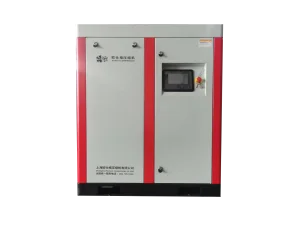
OEM 30kW Water Lubricated Oil Free VSD Screw Air Compressor 380V 400V 415V Industrial Air Compressor Suppliers, Factory
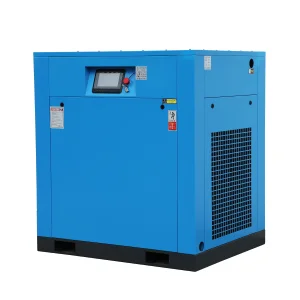
China Permanent Magnet VFD Rotary Screw Compressor 11kW Manufacturer, Manufacturers
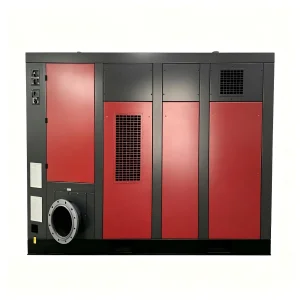
OEM High Precision Operational Safety Micro Oil Screw Vacuum Pump for Vacuum Industry Supplier, Exporters
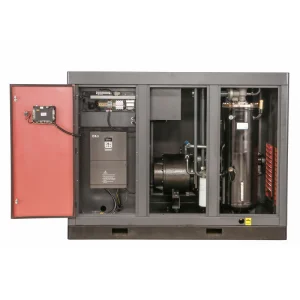
ODM Oil-cooled two-stage permanent magnet variable frequency screw air compressor Manufacturers, Suppliers
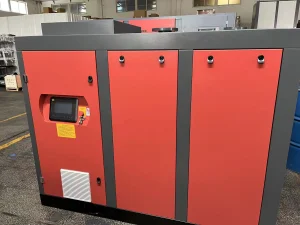
ODM electrical motor PM AC ASD rotary air vaccum pump compressor screw compressor Manufacturer, Manufacturers
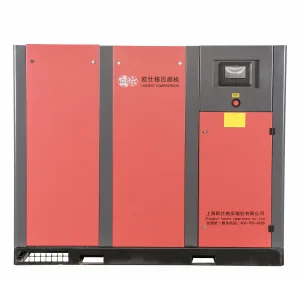
OEM Double permanent magnet motor integrated two-stage compression series Supplier, Factory
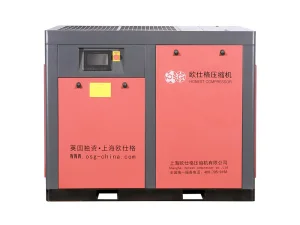
OEM Double screw air compressor with inverter and VSDPM motor for energy saving Manufacturer, Exporter
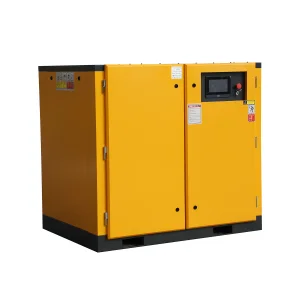
OEM 18.5kW 25HP Industrial VFD PM Screw Air Compressor Factory, Exporter
Frequently Asked Questions: Sizing, Sourcing & Compliance
Clear technical insights for plant engineers, procurement directors, and system integrators sourcing 50 HP screw compressors from Chinese manufacturing hubs.