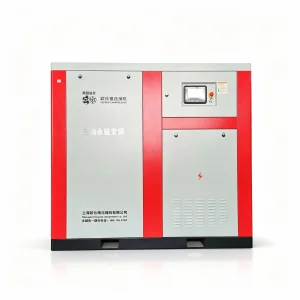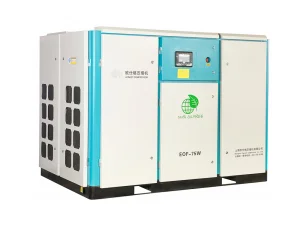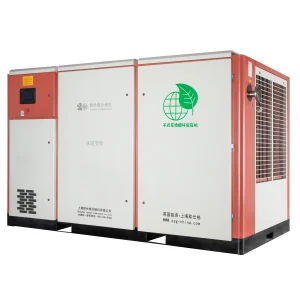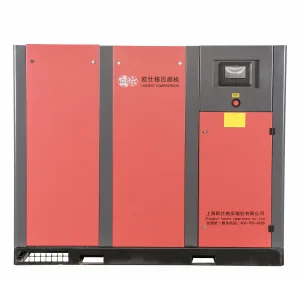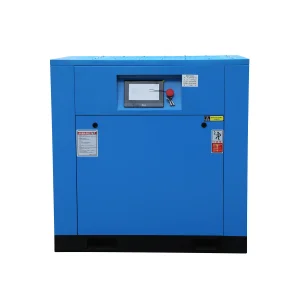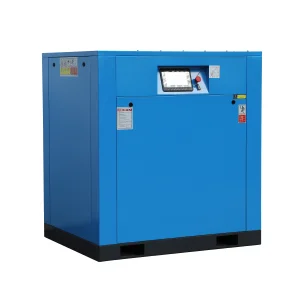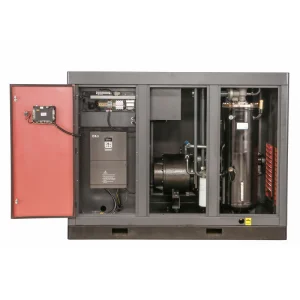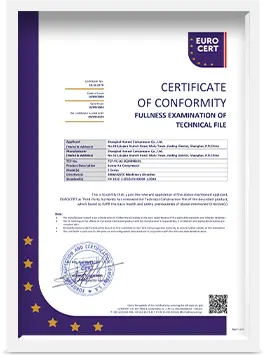
Featured Industrial Rotary Compressors & Systems
Engineered in Shanghai for continuous 24/7 duty cycles. Select from variable speed drives, explosion-proof units, two-stage compression, and specialized vacuum screw systems.
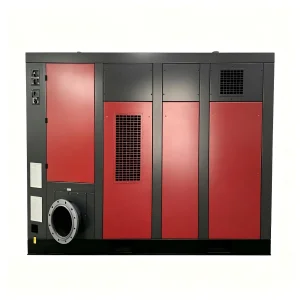
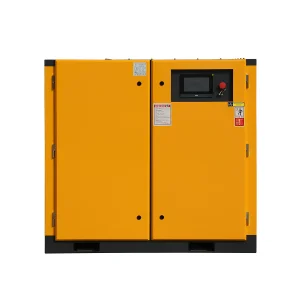
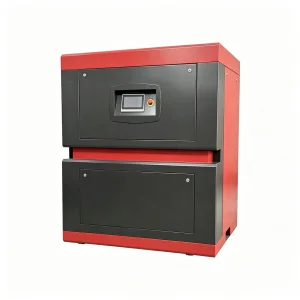
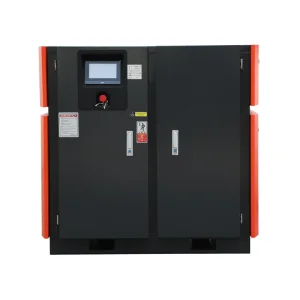
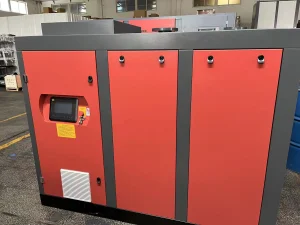
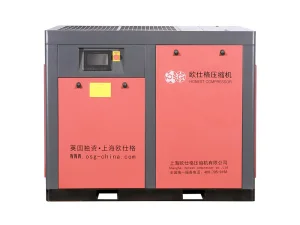

The Strategic Evolution of Electric Screw Compressors
Compressed air is historically labeled as the "Fourth Utility" alongside electricity, water, and natural gas. However, modern corporate carbon taxation and volatile energy markets have revolutionized how industrial facilities procure, monitor, and optimize positive displacement machinery.
Aggressive Decarbonization & Level 1 Efficiency Standards
Over a 10-year operating horizon, 76% to 82% of a compressor's Total Cost of Ownership (TCO) is consumed directly by electrical power, while initial equipment purchase accounts for merely 12% to 15%. Regulatory mandates such as the EU Ecodesign Directive (Lot 31), US Department of Energy (DOE) energy conservation rulings, and China's GB 19153-2019 standard have forced a transition from fixed-speed machines to advanced IE4/IE5 permanent magnet systems.
By adopting state-of-the-art aerodynamic screw profiles and modulating rotor speed dynamically, modern plants mitigate unnecessary off-load electricity waste by up to 35%.
Transition Toward ISO 8573-1 Class 0 Air Purity
The contamination risks associated with downstream oil aerosols have driven extreme demand for dry-screw and water-lubricated oil-free compression systems. High-precision manufacturing environments—notably biopharmaceuticals, food and beverage processing, high-density chip fabrication, and automotive paint booths—can no longer tolerate conventional coalescing filter failure risks.
China's manufacturing clusters have engineered dry-type coated rotors and stainless-steel water-lubricated chambers delivering guaranteed 0% residual oil across all operational pressures.
Intelligent Edge Automation & Real-Time Telemetry
Modern screw compressor plants are no longer isolated mechanical appliances. They represent sophisticated cyber-physical systems integrated with IoT edge controllers, Modbus-RTU, Profibus, and Ethernet-IP connectivity. Industrial plants utilize predictive maintenance matrices that assess bearing vibration signatures, inter-stage pressure gradients, and discharge dewpoints in real-time.
This connectivity eliminates unplanned catastrophic downtime, optimizing maintenance scheduling based on actual mechanical wear rather than arbitrary calendar dates.
What Global EPC Contractors & Factory Directors Prioritize
Navigating capital expenditure (CAPEX) versus operational life-cycle viability requires an uncompromising technical assessment. Below is the procurement evaluation hierarchy utilized by multinational industrial enterprises.
| Evaluation Vector | Legacy Fixed-Speed (Asynchronous) | First-Gen PM VFD Compressors | Advanced Two-Stage PM VFD (Industry 4.0 Benchmark) |
|---|---|---|---|
| Specific Power (kW / m³/min) | 7.2 – 8.1 @ 8.0 bar (High parasitic loss) | 6.4 – 7.1 @ 8.0 bar (Modulated flow) | 5.4 – 5.9 @ 8.0 bar (Thermodynamic optimization) |
| Motor Electrical Efficiency | IE2 to IE3 Induction (91% - 93.5%) | IE4 Permanent Magnet (94% - 95.8%) | IE5 Ultra-Premium PM Synchronous (>96.5%) |
| Unload State Energy Burn | Consumes 30%–45% full load power idling | Rapid stop/start; 0% idle burn | Zero idle burn; Frequency response 15Hz to 120Hz |
| Maintenance & Bearing Life | 20,000 – 30,000 operating hours | 35,000 – 45,000 operating hours | 60,000 – 80,000 hours (Reduced radial loads) |
| Noise & Harmonic Distortion | High mechanical resonance (75–82 dB) | Medium (68–74 dB); standard harmonics | Ultra-Quiet (<65 dB); Active harmonic filtering |
1. Power Grid Fluctuation Tolerance
Global sites in developing regions, heavy mining sectors, or isolated industrial zones often struggle with erratic input voltages (±15% to ±20%) and harmonic distortion. Professional procurement requires variable frequency inverters equipped with integrated DC reactors, transient surge suppression, and heavy-duty insulated-gate bipolar transistors (IGBTs) capable of preventing trip-outs under voltage sags.
2. Extreme Ambient Thermal Management
Standard compressors derate or overheat when ambient temperatures exceed 40°C. Sourcing directors require oversized plate-fin aluminum coolers or shell-and-tube heat exchangers, high-viscosity synthetic synthetic polyalphaolefin (PAO) lubricants, and IP55/IP65 completely enclosed fan-cooled (TEFC) motor enclosures that guarantee non-stop performance at up to 48°C ambient conditions.
3. Modularity & Plug-and-Play Footprints
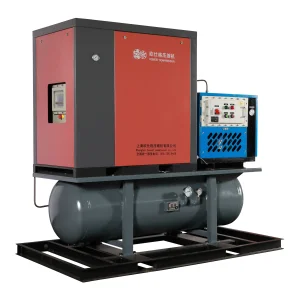
Modern factory floors command premium square-meter valuations. Procurement has shifted decisively toward skid-mounted "All-In-One" or "4-in-1" integrated packages incorporating the rotary compressor, ASME/CE air receiver vessel, refrigerated cycling dryer, and multi-stage coalescing filtration systems onto a single isolated structural baseframe.
China Factory 4.0: Engineering Rigor & Supply Chain Resilience
How our Shanghai manufacturing facility leverages vertically integrated production, nanometer-level CNC profiling, and automated robotic assembly to deliver unbeatable technical value to global exporters and distributors.
Robotic Ductile Iron Casting
All rotor and casing housings originate from stress-relieved high-density ductile iron (QT450-10). Automated thermal resonance tempering stabilizes mechanical grain boundaries, preventing structural micro-deformation during extreme thermal operational spikes.
Five-Axis CNC Rotor Milling
Using state-of-the-art German and Japanese grinding systems, our male-female helical screw profiles are machined to a tolerance within ±0.002mm. The proprietary asymmetric 5:6 tooth ratio minimizes internal blow-hole leakage, boosting volumetric displacement by 10-12%.
Dynamic Balancing & CMM Audit
Every rotor assembly undergoes computerized dynamic balancing per ISO 1940 Grade G1.0, paired with Coordinate Measuring Machine (CMM) volumetric laser inspection. This eliminates radial runout, bearing heat buildup, and premature vibration degradation.
In-House Permanent Magnet Motors
Utilizing high-coercivity NdFeB (Neodymium-Iron-Boron) magnets rated to 180°C demagnetization resistance, our oil-cooled and air-cooled synchronous motors eliminate traditional rotor slip losses, maintaining 96%+ efficiency across a wide 20% to 100% speed envelope.
Agile OEM/ODM Modular Line
Our 50,000 m² facility features flexible smart lines tailored for bespoke client configurations: customized voltages (208V, 380V, 415V, 460V, 690V), dual 50Hz/60Hz frequency setups, custom PLC logic languages, explosion-proof ATEX/Ex d standards, and branded cabinet designs.
Rigorous ISO 1217 Testing
Before export crating, each unit runs for 4 hours continuous duty under full load conditions. Orifice plate flow verification per ISO 1217 Annex C, sound-power spectrum measurements, oil carry-over testing, and high-voltage insulation tests are documented in a formal Factory Acceptance Report.
Mission-Critical Deployment Across Global Industries
From extreme desert conditions to sanitary microelectronics cleanrooms, our electric screw compressor architectures are specifically calibrated for diverse operational challenges.
Semiconductor & Photovoltaic Cleanrooms
Challenge: Wafer handling, laser cutting, and solar cell screen printing demand particulate-free, completely moisture-free (-40°C pressure dew point), and absolute zero-oil compressed air. Any oil vapor ruins silicone substrate wafers.
Engineered Solution: Deployment of EOF-Series dry-screw oil-free compressors or water-lubricated stainless steel units combined with desiccant heatless air dryers, guaranteeing ISO 8573-1 Class 1.2.0 quality standards.
Automotive Body Welding & Precision Spray Coating
Challenge: Multi-axis welding robots and high-speed electrostatic paint booths suffer from severe pneumatic pressure fluctuations during shifts, resulting in orange-peel paint defects and erratic weld clamps.
Engineered Solution: Implementation of Two-Stage PM VFD air compressor arrays with centralized smart PLC sequencing. Motor velocity responds in milliseconds to pressure variances as tight as ±0.01 MPa, eliminating cycle defects.
Food, Dairy & Pharmaceutical Packaging
Challenge: Blister packaging, bottle blow molding, aseptic milk bottling, and tablet dusting require continuous compliance with FDA and European Pharmacopoeia air standards.
Engineered Solution: EOWV water-lubricated screw units utilizing municipal purified water as the cooling/sealing medium. Temperatures stay well below 50°C, delivering near-isothermal compression with zero carbon footprint.
Heavy Chemical & Explosive Vapor Zones
Challenge: Petrochemical refining, fertilizer plants, and underground mining face volatile hydrocarbon vapors (Zone 1/Zone 2) where standard electrical arcing triggers catastrophic explosions.
Engineered Solution: ATEX/Ex d IIB/IIC explosion-proof skid-mounted systems. Enclosed flameproof electrical cabinets, non-sparking bronze belt sheaves, antistatic cooling fans, and hermetic sensor housings.
High-Altitude Mining & Desert Tunneling
Challenge: Low air density at high elevations (over 2,500m) leads to severe compressor motor overheating, air delivery derating, and heavy abrasive dust clogging intake filters.
Engineered Solution: Heavy-duty dual-stage nano-synthetic air intake filtration, motor insulation grade H (180°C thermal margin), and enlarged air-end displacement customized for altitude atmospheric compensation.
High-Speed Textile Looms & Precision Laser Cutters
Challenge: Air-jet spinning mills and multi-kilowatt fiber laser cutting heads require massive continuous volume at elevated pressures (1.6 MPa to 3.0 MPa) with minimal pressure drop.
Engineered Solution: Medium-to-high pressure horizontal two-stage compression screw platforms featuring oversized stainless oil separator tanks, maintaining oil carry-over below 1.5 PPM.
Frequently Asked Engineering & Procurement Questions
Authoritative, clear answers to technical questions concerning compressor sizing, motor efficiency, oil-free compliance, and international shipping protocols.
How does a two-stage rotary screw compressor achieve superior specific power compared to single-stage units?
Single-stage compression requires high pressure ratios within a single rotor chamber (e.g., from ambient 0.1 MPa up to 0.8 MPa, a compression ratio of 8:1). This creates massive thermodynamic heat buildup, accelerating internal gas back-leakage around rotor clearance gaps and pushing compression behavior far from optimal isothermal conditions toward an energy-wasting adiabatic profile.
Two-stage compression divides the compression ratio across two sequential screw rotor pairs (e.g., Stage 1 compresses to ~0.32 MPa, Stage 2 completes up to 0.8 MPa, yielding gentle ratios of ~2.8:1 per stage). An atomized oil-curtain or liquid inter-stage cooler reduces gas temperature between stages. This reduction in inlet air temperature for Stage 2 significantly increases air density, requiring drastically less mechanical shaft work. The net engineering result is an immediate 12% to 18% specific energy reduction (kW/m³/min), alongside lowered bearing radial thrust loads that extend air-end lifespan beyond 80,000 continuous hours.
What is the exact distinction between ISO 8573-1 Class 1 and Class 0 Oil Purity?
Under ISO 8573-1:2010 regulations, Class 1 compressed air allows for a residual total oil concentration (including liquid droplets, aerosol droplets, and organic vapor) of up to 0.01 mg/m³ at standard atmospheric conditions. While this is acceptable for general metal fabrication, it carries inherent contamination hazards if downstream line filters saturate or blow out.
In contrast, Class 0 is an open-ended, significantly more stringent classification. The manufacturer and end-user must specify measurable total hydrocarbon levels lower than Class 1 (typically tested below 0.003 mg/m³ or absolute zero detection). Furthermore, genuine Class 0 dry-type or water-lubricated compressors contain no oil in the compression chamber whatsoever, meaning it is physically impossible for oil lubricants to migrate into the process air stream under any mechanical component failure.
Why is Permanent Magnet Variable Frequency Drive (PM VFD) superior to legacy Star-Delta induction drives?
Traditional fixed-speed motors operate on a Star-Delta start cycle. When the facility's pneumatic system reaches upper pressure limits, the compressor does not shut down (which would overheat the motor windings from rapid cycling). Instead, it enters an "unload" or idle state, blowing off receiver air while keeping the motor running at 100% RPM. In this unload state, the compressor consumes 30% to 45% of its rated electrical power doing zero useful work.
A Permanent Magnet Synchronous Motor (PMSM) controlled by a closed-loop VFD matches motor rotation speed directly to real-time cubic meters per minute (m³/min) consumption. If air demand drops by 40%, the motor slows down proportionally, reducing electricity consumption by 40%. Additionally, PMSM rotors feature embedded rare-earth magnets that eliminate electrical copper rotor excitation losses, remaining above 96% efficiency even at partial loads (down to 25% rated speed). This eliminates mechanical starting torque spikes, maintaining a power factor (PF) near 0.98.
How does ambient temperature and elevation affect compressor sizing calculations?
Compressor free air delivery (FAD) is measured based on standard ambient conditions (typically ISO 1217: 20°C, 1 bar absolute pressure, 0% relative humidity). When designing a system for high elevations or desert locations, two thermodynamic factors occur: decreased inlet air density and diminished cooling radiator convection.
At 2,000 meters above sea level, atmospheric pressure drops to approximately 0.79 bar. To achieve a discharge flow of 10 m³/min at 0.8 MPa gauge, an oversized air-end displacement is required to ingest greater mass flow. Concurrently, thin air reduces motor convection cooling efficiency, requiring high-temperature insulation classes (Class H) and lower operational thermal rise limits (Class B rise) to prevent thermal trip-outs. Our application engineers provide altitude-compensated sizing charts for every export project.
What OEM / ODM customization parameters are supported for international brand importers?
As a vertically integrated Shanghai manufacturer, we offer comprehensive white-label and ODM manufacturing scopes:
- Electrical Architecture: 3-phase 208V, 220V, 380V, 400V, 415V, 460V, 480V, 600V; 50Hz or 60Hz; UL-508A, CE, or CSA-compliant control cubicles.
- PLC & HMI Controllers: 7-inch or 10-inch full-color touchscreens customized with your proprietary corporate firmware, custom Modbus register maps, multi-language UI (English, Spanish, French, Russian, Arabic, German), and branded 4G/Wi-Fi remote monitoring telematics.
- Structural & Enclosure: Custom RAL powder-coat cabinet colors, stainless steel corrosive-environment canopies, sound-attenuating labyrinth ducting down to 62 dB(A), skid-mounted dryer/tank configurations.
- Engineering Compliance: Pressure vessels certified to ASME Section VIII Div 1 with U-stamp, European CE-PED, Australian AS1210, or Singapore MOM standards.
What maintenance schedules are mandated to preserve maximum specific efficiency?
Maintaining peak thermodynamic efficiency requires structured preventative interventions:
- 500 Hours (Initial Commissioning): Initial oil filter change and electrical terminal torque audit to eliminate transport settling.
- Every 2,000 – 3,000 Hours: Replacement of high-efficiency nano-synthetic air intake filter elements (holding DP below 20 mbar) and spin-on oil filter cartridges. Lubricant sampling for kinematic viscosity, total acid number (TAN), and particle count.
- Every 4,000 – 6,000 Hours: Replacement of the three-stage air/oil coalescing separator element to ensure discharge air oil carryover remains under 2 PPM, alongside full synthetic polyalphaolefin (PAO) fluid replacement.
- Every 20,000 Hours: Dynamic bearing inspection, solenoid kit overhaul, minimum pressure valve (MPV) reseating, and thermostatic valve expansion element replacement.
How does Honest Compressor protect machines against export shipping corrosion?
Ocean freight journeys through tropical maritime routes subject machinery to severe salt-spray humidity and rapid temperature cycling, creating internal dewpoint condensation. We implement an intensive multi-barrier packaging protocol: every bare metal surface, rotor intake port, and air receiver is chemically treated with high-grade vapor-phase corrosion inhibitors (VCI).
The complete compressor unit is sealed in a heavy-gauge vacuum-evacuated aluminum foil barrier wrap with activated desiccant packs. The machine is securely bolted to fumigated solid-timber or heavy-gauge steel export pallets and enclosed in reinforced export-grade plywood crates, ensuring pristine operational arrival at overseas container terminals.
Specialized High-Efficiency Rotary Compressor Lineup
Explore our oil-free water-lubricated series, extreme power dry-screw platforms, heavy two-stage compression frames, and single-phase PM solutions.