Featured High-Efficiency Compressors (Batch 01)
Direct-coupled industrial air compression systems, water-lubricated oil-free units, and multi-stage rotary screw configurations designed for 24/7 continuous duty cycles.
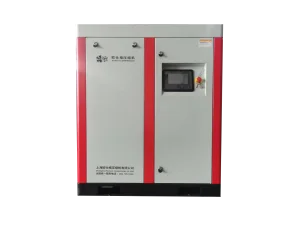
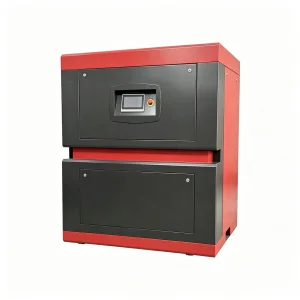
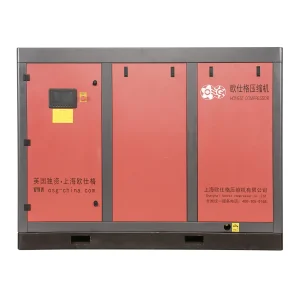
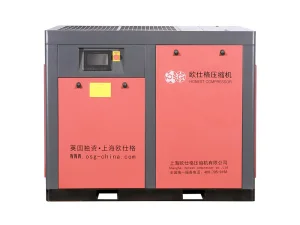
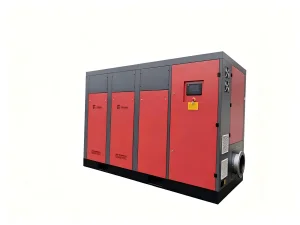
The Enduring Engineering Value of Fixed Speed Air Compressors in Global Manufacturing
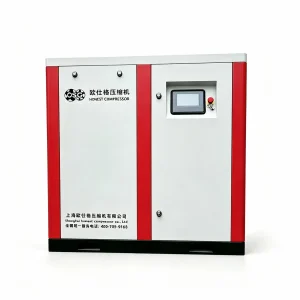
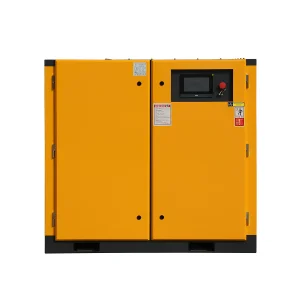
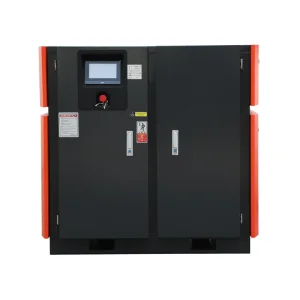
In modern industrial utility design, variable frequency drives (VFD) are frequently celebrated for fluctuating demand cycles. However, seasoned mechanical utility consultants, plant chief engineers, and large-scale EPC contractors recognize that Fixed Speed Rotary Screw Air Compressors remain the absolute foundational pillar of global baseload compressed air production. In baseline load environments where plant air consumption remains continuously above 85% to 90% of plant design capacity, fixed speed rotary screw compressors demonstrate unmatched thermodynamic and electrical advantages. Operating directly off premium-efficiency inductive drives without harmonic distortion losses, inverter heat penalties, or pulse-width modulation (PWM) motor insulation stress, high-quality fixed speed compressors supply consistent volumetric flow (Free Air Delivery per ISO 1217 Annex C) at maximum isentropic efficiency.
As premier China fixed speed air compressor suppliers and global exporters, our manufacturing methodology focuses on heavy-duty, direct-coupled rotor geometries (5:6 asymmetric tooth profiles) engineered to operate within optimal circumferential tip velocity envelopes (28 to 35 m/s). This precise dimensional design mitigates internal backflow slippage across pressure differentials from 7.0 bar to 13.0 bar. When integrated into balanced, multi-compressor industrial header networks, fixed speed units operate at an unwavering, continuous full-load state, delivering peak kilowatt-hour-to-mass-flow ratios that variable-speed units struggle to outperform under unyielding full-throttle conditions.
Fixed Speed vs. Variable Speed (VFD) vs. Two-Stage Compression
Comprehensive engineering evaluation for procurement engineers, comparing initial CapEx, lifetime OpEx, harmonic stability, and environmental robustness.
| Evaluation Parameter | Fixed Speed Screw Compressor | PM VFD (Variable Speed) | Two-Stage Direct Drive Screw |
|---|---|---|---|
| Primary System Role | Continuous Base-Load Utility (85%-100% Demand) | Trimming / Modulating Variable Load | Mega-Scale Base-Load Chemical & Heavy Process |
| Full-Load Specific Energy | Optimal (Zero Inverter Parasitic Conversion Loss) | Good (Loss of 2.5–3.5% through Inverter Rectifiers) | Superlative (Approaching Isothermal Compression, -12% kWh) |
| CapEx & Payback Period | Lowest Initial CapEx; Immediate Rapid ROI | Higher CapEx (Inverter, Encoders, Thermal Sensors) | Highest Initial Investment (Dual Airends, Intercooling) |
| Grid Harmonic Footprint | Zero Harmonic Injection (Pure Sinusoidal THD < 1%) | Requires Active Front-End or EMC/RFI Filter Arrays | Zero Harmonic Injection on Direct Line-Start Motors |
| Harsh Environment Resilience | Immune to extreme ambient moisture, dust, and sulfur | Sensitive inverter electronics require climate enclosures | Extremely rugged mechanical footprint |
| Bearing Maintenance Interval | Exceeds 50,000–80,000 running hours with SKF/FAG | Requires insulated ceramic bearings against shaft currents | Ultra-low bearing loads due to divided pressure ratios |
| Control Simplicity | Fail-safe Star-Delta Electro-pneumatic logic | Microprocessor-driven vector control & bus protocols | Multi-point PLC cascade monitoring |
Next-Generation Technological Evolutions in Fixed Speed Architecture
How Chinese precision manufacturing and aerodynamic refinements have fundamentally elevated conventional fixed speed rotary compressors into high-tier, connected assets.
Third-Generation Asymmetric Rotors
Engineered using German Klingelnberg and Holroyd ultra-precision 5-axis grinding lines. Rotor profiles maintain micron-level clearance (0.003–0.005 mm) to virtually eliminate blow-hole leakage, boosting volumetric displacement by 8% over generic profiles.
Integrated Thermodynamic Heat Recovery
Over 80% to 90% of electrical shaft input manifests as thermal rejection in the lubricant and discharge gas. Our fixed speed packages incorporate direct shell-and-tube or plate heat exchangers, delivering hot water up to 75°C for boiler feed or plant heating.
Intelligent Auto-Dual Modulation Logic
Modern PLC systems integrate smart load/unload cycles combined with delayed automatic stoppage. If the network pressure reaches upper cut-out parameters during shift changeovers, the unit runs idle for an optimized duration before shutting down safely.
Heavy-Duty Triple Separation System
Centrifugal cyclone separation combined with gravity settlement and high-efficiency borosilicate micro-fiber separator elements ensures residual oil carry-over below 2 ppm, dramatically extending inline desiccants and filter lifespan downstream.
Suction throttling geometry is aerodynamically smoothed to diminish intake vortex head losses, lowering mechanical resistance across the inlet intake valve by 14%.
Installation of back-to-back paired SKF explorer bearings specifically engineered to absorb dynamic axial thrust, maintaining rigid shaft clearances up to 100,000 operating hours.
Integration of low-loss cold-rolled silicon steel sheets with cast aluminum or copper rotors, complying with strict global GB 19153 Class 1 and EU Ecodesign directives.
On-board RS-485 Modbus RTU / Ethernet interfaces streaming airend vibration frequencies, bearing surface temperatures, and separator delta-P values directly to plant SCADA.
Localized Industrial Applications: Thriving Under Extreme Working Conditions
From cement plants in the Middle East to deep chemical refining in Southeast Asia, examine why fixed speed machines excel in uncompromising production sectors.
Mining, Cement & Heavy Quarrying
High concentrations of abrasive airborne particulate matter (silica, limestone, clinker dust) choke sensitive inverter circuitry. Fixed speed compressors utilize oversized two-stage cyclonic heavy-duty air inlet filters with filtration efficiency of 99.9% at 3 microns, coupled with sealed IP55/IP65 electrical cabinets to ensure dust never compromises contactors or mechanical linkages.
Continuous Petrochemical & Gas Refining
Petrochemical cracking towers, sulfur recovery units, and gas synthesis stations run non-stop for 8,000 hours per annum. An unscheduled trip costs tens of thousands of dollars per hour. Fixed speed rotary screws operate without fragile firmware boot loops, delivering steadfast pneumatics for instrumentation, nitrogen generation feed, and emergency pneumatic valve control.
Textile Spinning & Air-Jet Looms
Air-jet weaving facilities require relentless pressure stability within ±0.1 bar to prevent yarn breakage and weaving inconsistencies. Operating multiple fixed-speed 75kW or 110kW units guarantees the voluminous mass flow required by hundreds of high-speed nozzles without cycle pressure oscillations.
Tropical High-Ambient & Arid Zones
Deployments across the Middle East, Latin America, and Sub-Saharan Africa experience ambient conditions climbing to 46°C–50°C. Our export models utilize oversized aluminum bar-plate oil/air coolers with 30% surplus thermal margin and high-static-pressure centrifugal exhaust fans to prevent thermal overload shutoffs.
The Base-Load Hybrid Pairing: The Golden Ratio of Industrial Air Design
Why leading global consulting engineers deliberately specify a combination of Fixed Speed and VFD compressors to optimize lifecycle economics.
One of the most persistent misconceptions in industrial compressed air procurement is that an entire compressor house must consist solely of Variable Frequency Drive (VFD) units. Rigorous empirical auditing of tier-one automotive plants, glass smelting facilities, and steel fabrication yards demonstrates that this approach is economically and electrically flawed.
In a facility demanding 100 m³/min of compressed air at 8.0 bar, the optimal engineering configuration—referred to in industrial pneumatics as the "Golden Ratio Pairing"—consists of 70% to 80% fixed speed base-load capacity (e.g., two 200kW fixed-speed compressors) coupled with 20% to 30% variable-speed trimming capacity (e.g., one 90kW PM VFD compressor). In this master-sequenced architecture:
- The Fixed Speed compressors run perpetually at 100% full capacity where their specific mechanical efficiency is mathematically at its peak, providing smooth, unchopped power grid performance with zero inverter switching losses.
- The VFD compressor tracks only the intermittent, dynamic fluctuations caused by shifting assembly lines or batch tool triggers.
- The plant saves up to 40% in initial capital equipment expenditure (CapEx) compared to an all-VFD compressor room, while maintaining an identical or superior energy efficiency profile (OpEx).
- In the event of electronic component failure on the VFD side, the heavy-duty fixed speed units ensure that 80% of critical manufacturing remains online without interruption.
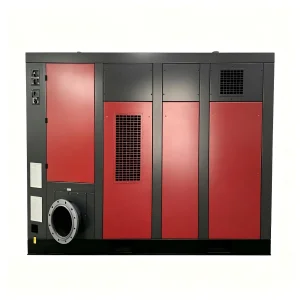
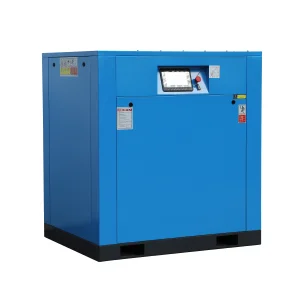
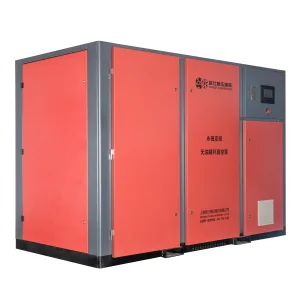
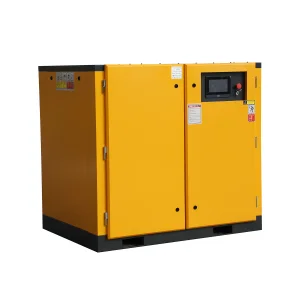
Specialized Industrial Compressors, Blowers & Vacuum (Batch 02)
High-pressure laser cutting screw compressors, explosion-proof models, permanent-magnet oil-free vacuum blowers, and two-stage heavy process systems.
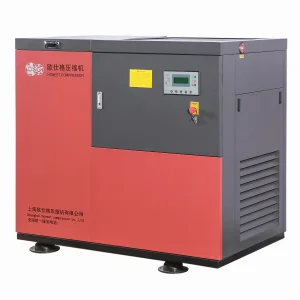
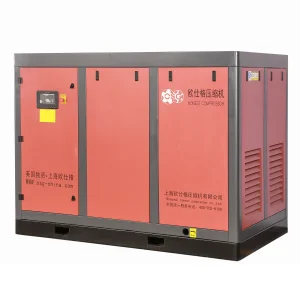
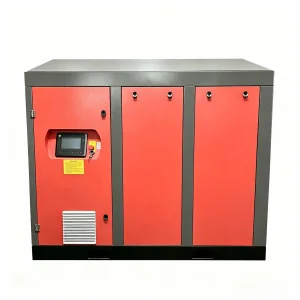
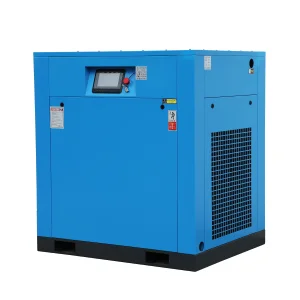
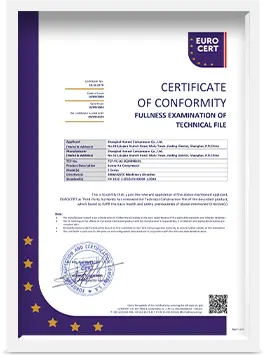
Strict Testing Protocols for Turnkey Global Export
Comprehensive ISO 1217 Annex C testing, full voltage flexibility (220V/380V/415V/440V/460V at 50Hz/60Hz), and sea-worthy export crating engineered for long-distance transit.
ISO 1217 Annex C Performance Benchmarking
Every fixed speed compressor undergoes rigorous automated nozzle testing on our computerized test rig prior to crating. Free Air Delivery (FAD), shaft input power, specific energy consumption (kW/m³/min), discharge temperature, and mechanical vibration velocity (ISO 10816-1) are systematically recorded and supplied as a factory certificate.
Worldwide Electrical Adaptation
Global export demands precise electrical flexibility. We configure factory motors and control cabinets for 380V/50Hz (Europe/Asia), 400V/50Hz (Oceania/Africa), 415V/50Hz (UK/Commonwealth), 460V/60Hz (North America), and 220V/380V dual-voltage settings (Latin America) with certified Schneider and ABB contactors.
Heavy-Duty Vacuum Hermetic Packaging
To combat marine humidity and salinity during long ocean transit, machines are treated with internal preservative anti-corrosion lubrication, sealed in barrier foil with silica desiccant bags, and enclosed within fumigated ISPM-15 compliant solid timber transport crates.
Frequently Asked Engineering Questions
In-depth responses covering thermodynamic sizing, electrical starting, mechanical maintenance intervals, and global export qualification.