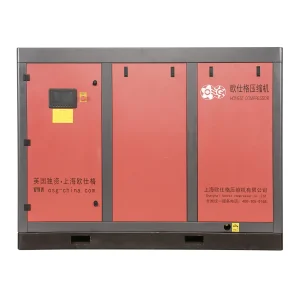
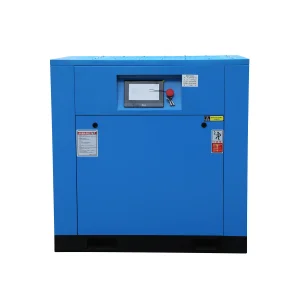
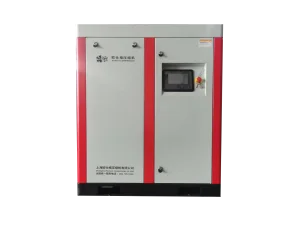
High-Efficiency 10 Bar & Multi-Pressure Rotary Screw Systems
Engineered for 24/7 heavy-duty industrial duty cycles. Select models feature Permanent Magnet VFD, Two-Stage Compression, and ISO 8573-1 Class 0 Oil-Free Technology.

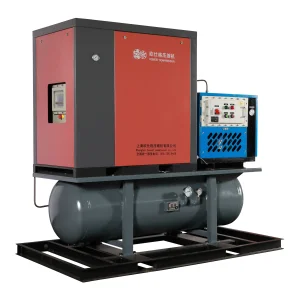
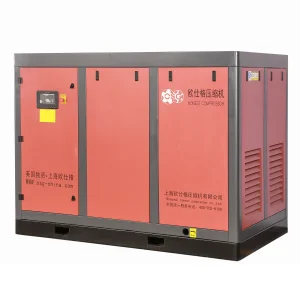
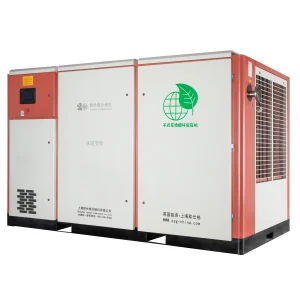
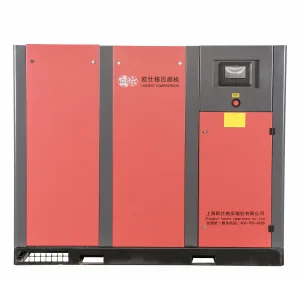
Executive Summary & Thermodynamic Fundamentals of 10 Bar (145 PSI) Air Compression
In global manufacturing, 10 Bar (1.0 MPa or 145 PSI) gauge pressure has emerged as the definitive benchmark standard for pneumatic power distribution. Across Europe, the Middle East, Southeast Asia, and South America, facility engineers specify 10 Bar rotary screw air compressors to offset line pressure losses caused by extensive piping headers, desiccant air dryers, micro-coal-filter assemblies, and rapid air consumption spikes from automated machinery.
Operating a positive displacement rotary screw air compressor at 10 Bar requires balancing thermodynamic efficiency, rotor profile geometry, thermal dissipation, and motor loading. When atmospheric air is drawn into the compressor airend at $P_1 = 1.0\text{ bar(a)}$ and compressed to $P_2 = 11.0\text{ bar(a)}$ (absolute), the internal pressure ratio ($\Pi = P_2 / P_1$) reaches 11:1. This elevated pressure ratio generates significant heat of compression according to the ideal gas law relationship:
Thermodynamic Heat Generation Formula:
$$T_2 = T_1 \times \left( \frac{P_2}{P_1} \right)^{\frac{k-1}{k}}$$
Where $T_1$ is ambient inlet temperature, $P_2/P_1$ is the pressure ratio (11.0 for 10 Bar gauge operating at sea level), and $k$ is the isentropic expansion factor ($\approx 1.4$ for dry air). Without advanced lubricant injection or inter-stage cooling, discharge temperatures would exceed $260^\circ\text{C}$, leading to thermal expansion of rotors, lubricant breakdown, and catastrophic airend seizure.
To overcome these physical limitations, leading China screw compressor 10 Bar suppliers like Shanghai Honest Compressor Co., Ltd. utilize specialized SAP/GH asymmetrical rotor profiles (5:6 or 4:6 gear ratios) paired with liquid-injected cooling or multi-stage intercooling. These advancements maintain internal operating temperatures between $82^\circ\text{C}$ and $95^\circ\text{C}$, ensuring optimal oil viscosity, minimal thermal bypass loss, and superior volumetric efficiency ($\eta_v > 95\%$).
Why Global Enterprises Sourcing 10 Bar Screw Compressors Partner with China Manufacturers
China's industrial automation clusters, specifically in the Yangtze River Delta (Shanghai, Jiangsu, Zhejiang), have evolved into the world's primary epicenter for high-precision screw compressor engineering.
Component Integration & Cost Scaling
China's mature supply chain permits seamless integration of world-class sub-components—such as SKF/FAG heavy-duty bearings, Inovance/Vichi vector frequency inverters, and IE4/IE5 ultra-premium permanent magnet motors—at a total capital cost 30% to 50% lower than Western European alternatives.
IE4 & IE5 PM VFD Motor Efficiency
China manufacturers lead the industrial adoption of NdFeB (Neodymium Iron Boron) Permanent Magnet Synchronous Motors. Operating without rotor slip, these motors maintain high motor efficiency (>96.5%) even under partial load conditions down to 25% capacity.
Rigorous QA & International Certification
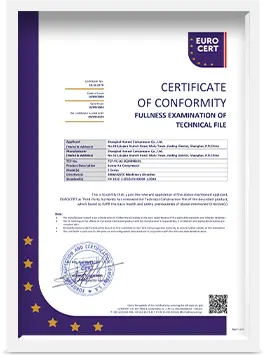
Top-tier Shanghai factories operate under strict ISO 9001 quality systems and ISO 14001 environmental frameworks. Equipment is certified under European CE directives, ASME pressure vessel codes, and Class 0 air purity standard ISO 8573-1.
E-E-A-T Insights (Engineering Experience): Founded in 2004 with British heritage roots, Shanghai Honest Compressor Co., Ltd. operates a 50,000 m² modern manufacturing plant in Jiading District, Shanghai. Combining European twin-screw geometric design principles with Chinese precision CNC rotor milling (KAPP / Holroyd thread grinders), Honest Compressor delivers 10 Bar air systems with specific power consumption as low as $5.8\text{ kW/(m³/min)}$, exceeding China National Level 1 Energy Efficiency standard (GB 19153-2019).
Macro-Industry Trends & Innovations in 10-Bar Compressed Air
As global industrial decarbonization accelerates, compressed air technology is undergoing a paradigm shift toward variable speed drives, two-stage compression, oil-free purity, and smart IoT telemetry.
1. PM VFD (Permanent Magnet Variable Frequency Drive)
Traditional fixed-speed compressors operate on a wasteful Load/Unload cycle, idling at 30–40% full-power draw without producing air during low-demand periods. 10 Bar PM VFD compressors continuously adjust motor RPM to match real-time plant air demand, maintaining target system pressure within $\pm 0.1\text{ Bar}$ while eliminating unload power losses entirely.
2. Two-Stage Screw Air Compression Efficiency
For high-volume continuous industrial plants (>37 kW), two-stage screw air compressors divide the overall 10 Bar pressure ratio into two steps: Stage 1 compresses ambient air to $\approx 3.2\text{ Bar}$, followed by inter-stage oil curtain cooling, before Stage 2 compresses air to final 10 Bar pressure. This lowers inter-stage work and thermal stress, boosting specific air output by 12–18% per kW.
3. Transition to ISO 8573-1 Class 0 Oil-Free Purity
To safeguard critical manufacturing environments from hydrocarbon fouling, 10 Bar oil-free compressors utilize water-lubricated ceramic rotors or dry-type twin-screw assemblies coated with UltraCoat Teflon polymers. Pure water injection acts as both lubricant and coolant, yielding 100% oil-free certified compressed air.
4. Industry 4.0 PLC Control & Predictive Telemetry
Modern 10 Bar compressors feature micro-processor color touch-screen controllers equipped with RS485 Modbus, CAN-bus, and IoT Cloud connectivity. Plant operators monitor system pressure, dewpoint, vibration spectrums, oil filter pressure differential, and real-time power consumption remotely from any browser or mobile app.
Localized Application Scenarios & Tailored Macro-Industry Solutions
Discover how specialized 10 Bar rotary screw air configurations address exact working conditions across diverse manufacturing, processing, and hazardous industrial environments.
1. Fiber Laser Cutting Industry (10 Bar – 20 Bar Air Assist)
In high-speed sheet metal laser cutting (carbon steel, stainless steel, aluminum alloys), high-pressure compressed air serves as an economical assist gas, blowing molten metal away from the cut kerf while cooling the laser head optics. 10 Bar to 20 Bar PM VFD compressors equipped with integrated cold-refrigerated air dryers, dual-stage precision particulate oil-removal filters, and a high-volume stainless air receiver deliver pressure dewpoints as low as $-40^\circ\text{C}$ PDP, guaranteeing clean oxidation-free cut edges without optical lens contamination.
2. Chemical, Petrochemical & Hazardous Explosive Zones
Refineries, solvent processing facilities, and coal chemical plants require explosion-proof compressed air machinery certified for Zone 1 or Zone 2 hazardous areas. OEM 4-in-1 explosion-proof air compressors ($7.5\text{ kW}$ to $22\text{ kW}$) incorporate Ex d IIB T4 / Ex d IIC T4 explosion-proof electric motors, anti-static V-belts or direct couplings, flameproof electrical cabinets, and copper-alloy non-sparking cooling fan impellers to ensure complete operational safety.
3. Food, Beverage & Pharmaceutical Sterile Packaging
In automated pill tableting, liquid bottle blowing, and MAP (Modified Atmosphere Packaging), compressed air comes into direct contact with ingestible products. Standard oil-injected compressors—even with multiple inline coalescing filters—present a residual risk of oil vapor carryover. Water-lubricated oil-free VSD screw compressors ($30\text{ kW}$ to $55\text{ kW}$) run with zero hydrocarbons in the compression chamber, ensuring 100% Class 0 sterile air output that passes stringent FDA and GMP audits.
| Compressor Technology Type | Operating Pressure (Bar) | Specific Power kW/(m³/min) | ISO 8573-1 Air Quality | Target Industrial Application |
|---|---|---|---|---|
| Single-Stage PM VFD Oil-Injected | 7.0 – 10.0 Bar | 6.8 – 7.2 kW | Class 2.4.2 (With Filters) | General CNC, Packaging, Stamping |
| Two-Stage PM VFD Oil-Injected | 8.0 – 13.0 Bar | 5.8 – 6.2 kW | Class 2.4.1 (With Filters) | Chemical Plants, Glass, Continuous Duty |
| Water-Lubricated PM VFD Oil-Free | 7.0 – 10.0 Bar | 6.4 – 6.8 kW | Class 0 (100% Oil-Free) | Pharma, Food & Beverage, Electronics |
| Laser Cutting Dedicated 4-in-1 | 16.0 – 20.0 Bar | 8.5 – 9.8 kW | Class 1.2.1 (-40°C Dewpoint) | Fiber Laser Cutting Assist Gas |
Global Enterprise Procurement Guide: Total Cost of Ownership (TCO) & Supplier Auditing
When procuring 10 Bar industrial screw air machinery from China, procurement teams must look beyond initial purchase price (CAPEX) to analyze 10-year Total Cost of Ownership (OPEX).
Over a standard 10-year operating lifespan ($60,000\text{ hours}$ at $6,000\text{ hours/year}$), the purchase price of an industrial screw compressor represents only 10% to 15% of its total cost. Maintenance and replacement filters account for 5% to 10%, while electricity costs consume 75% to 85% of total expenditure.
12% - CAPEX
Initial equipment purchase price, freight costs, import tariffs, and mechanical installation.
8% - Maintenance
Routine oil filters, air filter elements, oil separators, and synthetic lubricant fluid flushes.
80% - Electricity
Electrical energy consumed by the drive motor during $60,000+$ hours of factory operation.
Supplier Verification & Technical Audit Checklist
International buyers and OEM partners should evaluate prospective China screw compressor 10 Bar suppliers against the following core technical criteria prior to contract placement:
- Airend Manufacturing Pedigree: Verify whether the supplier precision-machines rotor pairs in-house using CNC thread grinders or purchases third-party low-tier airends.
- Specific Power Verification: Require third-party factory test reports according to ISO 1217 Annex C/E standards for Free Air Delivery (FAD) and shaft power measurement at 10 Bar.
- Voltage & Frequency Compatibility: Ensure motors and electrical control panels are engineered for destination grid standards ($380\text{V}/50\text{Hz}$, $400\text{V}/50\text{Hz}$, $415\text{V}/50\text{Hz}$, $460\text{V}/60\text{Hz}$, or $220\text{V}/3\text{Phase}$).
- Thermal Management System: Confirm radiator heat exchangers are oversized by at least $+25\%$ to operate reliably in tropical ambient environments reaching $+45^\circ\text{C}$ to $+50^\circ\text{C}$.
Single-Stage vs. Two-Stage Screw Compression at 10 Bar Pressure
A comparative thermodynamic study detailing work distribution, thermal stress mitigation, and energy savings for heavy industrial base load operations.
When selecting a 10 Bar screw compressor, plant engineers frequently weigh the decision between a lower initial cost Single-Stage unit and a higher efficiency Two-Stage machine. Understanding the internal fluid dynamics and pressure ratios reveals why two-stage compression delivers superior economics for large air demands (>55 kW).
Single-Stage 10 Bar Compression
In a single-stage machine, a single male and female rotor pair compresses ambient air directly from $1.0\text{ bar(a)}$ to $11.0\text{ bar(a)}$ in one continuous pocket reduction step. The single high-pressure ratio ($\Pi = 11$) results in:
- Increased rotor blow-by leakage across radial and axial sealing lines.
- Higher thermal loads requiring greater oil injection rates.
- Higher bearing thrust loads, decreasing bearing service life (L10h life $\approx 40,000\text{ hours}$).
Two-Stage 10 Bar Compression
Two-stage compressors utilize two distinct rotor sets housed in a dual-chamber casing or series layout. Stage 1 compresses air from $1.0\text{ bar(a)}$ to $\approx 3.3\text{ bar(a)}$ ($\Pi_1 \approx 3.3$). Stage 2 compresses air from $3.3\text{ bar(a)}$ to final $11.0\text{ bar(a)}$ ($\Pi_2 \approx 3.3$). Benefits include:
- Reduced pressure differential across each rotor pair, cutting blow-by leakage losses by over 60%.
- Inter-stage oil curtain lowers air inlet temperature entering Stage 2, approaching isothermal compression.
- Radial and thrust forces on bearings are significantly reduced (L10h life > 100,000 hours).
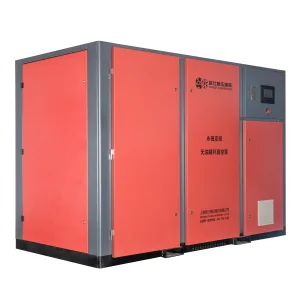
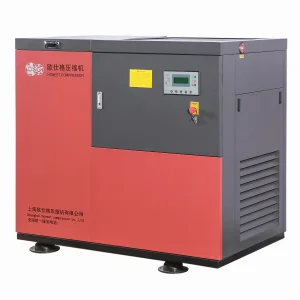
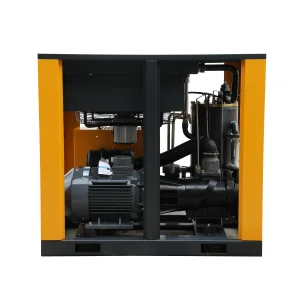
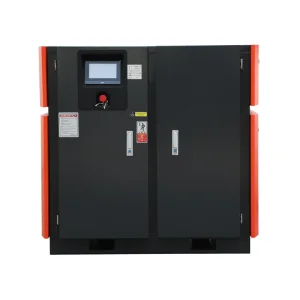
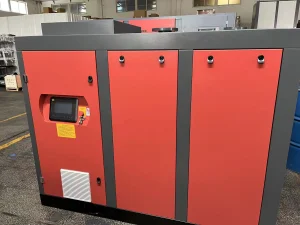
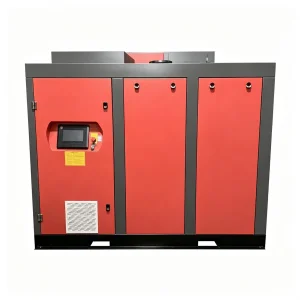
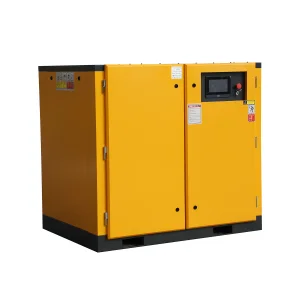
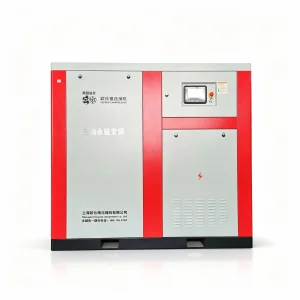
Specialized Screw Air Blowers, Vacuum Pumps & Laser Compressors
Explore specialized industrial solutions designed for process vacuum, low-pressure aeration, dry clean air, and high-pressure laser cutting assist applications.
Frequently Asked Questions (FAQ) — 10 Bar Screw Air Systems
Detailed answers compiled by Shanghai Honest Compressor senior application engineers to assist global buyers, procurement agents, and plant managers.
Why choose a 10 Bar (145 PSI) screw compressor instead of an 8 Bar (116 PSI) model?
An 8 Bar compressor provides insufficient pressure margin if your facility experiences significant piping pressure drops across dryers, filters, and long header runs, or if your end pneumatic equipment requires $7.5\text{ Bar}$ to $8.0\text{ Bar}$ net pressure at the tool interface. Selecting a 10 Bar unit ensures stable terminal operating pressure, compensates for filter element pressure differential build-up over time ($\Delta P \approx 0.2-0.5\text{ Bar}$), and allows room for expansion across automated production lines.
How much electricity can a PM VFD 10 Bar screw air compressor save annually?
On production sites with varying compressed air consumption, permanent magnet variable frequency drives (PM VFD) reduce energy consumption by 20% to 40% compared to fixed-speed load/unload compressors. For example, a $55\text{ kW}$ fixed-speed compressor operating $6,000\text{ hours/year}$ at $0.12\text{ USD/kWh}$ costs approximately $39,600\text{ USD}$ in power. A PM VFD machine saving an average of 28% electricity yields annual savings of $11,088 USD, fully recovering the initial compressor purchase price within 12 to 18 months.
What is the difference between water-lubricated oil-free and dry-type oil-free screw compressors?
Water-lubricated oil-free compressors inject purified reverse-osmosis (RO) water directly into the compression chamber to seal rotor clearances, lubricate ceramic bearings, and cool the air. Water's high specific heat capacity results in nearly isothermal compression at low operating temperatures ($<50^\circ\text{C}$). Dry-type oil-free compressors utilize timing gears and specialized Teflon/PVD synthetic polymer rotor coatings without liquid injection in the chamber, making them ideal for high-temperature or extreme chemical environments.
What technical data is required to correctly size a 10 Bar screw compressor?
To provide accurate engineering sizing, our team requires: (1) Total volumetric flow demand in $\text{m³/min}$ or $\text{CFM}$; (2) Required working pressure at point of use; (3) Electrical grid supply voltage, phase, and frequency ($V / \text{Phase} / \text{Hz}$); (4) Ambient site conditions (temperature range and altitude); (5) Required air dryness and cleanliness class under ISO 8573-1 (PDP dewpoint and oil content specs).
Does Shanghai Honest Compressor offer custom OEM / ODM manufacturing?
Yes. As an established direct factory exporter in Shanghai, we provide complete OEM and ODM customization. This includes custom voltage configurations ($380\text{V}$, $400\text{V}$, $415\text{V}$, $440\text{V}$, $460\text{V}$ at $50\text{Hz}$ or $60\text{Hz}$), custom PLC touchscreen languages (English, Spanish, French, Russian, Arabic), custom canopy colors, private label branding, and integrated skid-mounted 4-in-1 packages (compressor + tank + dryer + filter).
What maintenance schedule is recommended for a 10 Bar oil-injected screw compressor?
Standard preventive maintenance intervals include: (1) Air inlet filter replacement every 2,000 hours; (2) Oil filter replacement every 2,000 hours; (3) Synthetic rotary screw lubricant fluid change every 4,000 hours; (4) Oil-air separator element replacement every 4,000 hours or when pressure differential exceeds $0.8\text{ Bar}$. Routine maintenance ensures maximum airend efficiency and guards against premature rotor wear.